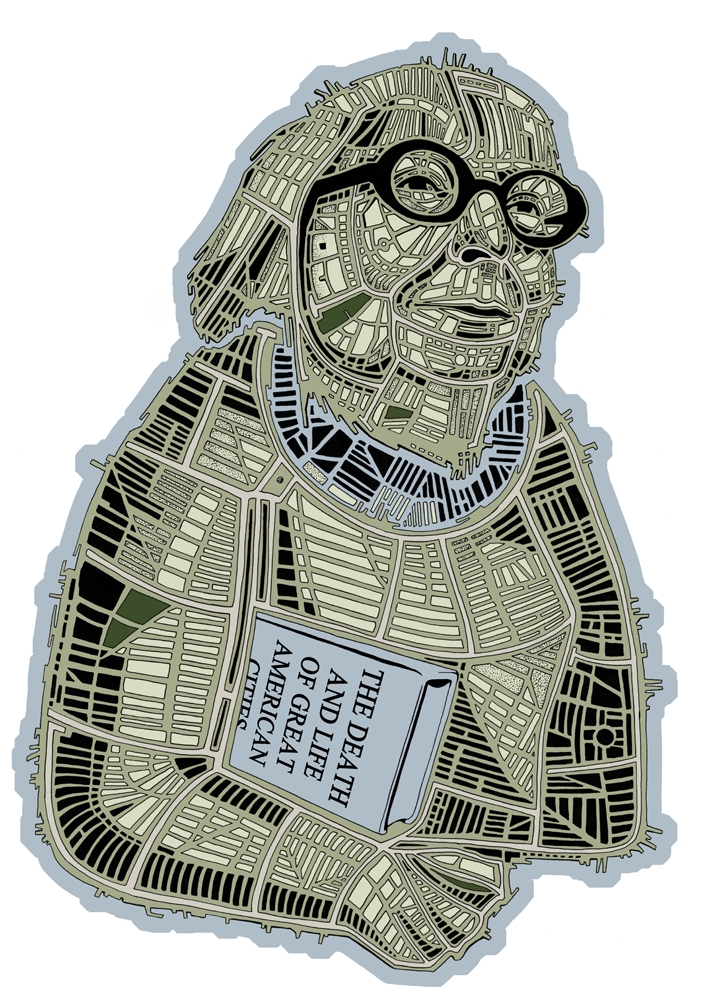
Book review: Wrestling with Moses: How Jane Jacobs Took on New York’s Master Builder and Transformed the American City, by Anthony Flint
A very interesting, well-written & well-researched book. (5 out of 5 stars)
Anybody with an interest in New York City, big city politics or urban design should find it worth reading. I came to it having read Jacobs’s famous book “The Death and Life of Great American Cities” and possessing the typical view of Jacobs as combination savant & saint, and Moses as evil incarnate for his ruthless transformations of the NYC landscape in favor of cars and trucks. But the book provides a more nuanced view.
First, I was surprised to learn that Jacobs’s famous book wasn’t the factor that changed hearts and minds and stemmed the tide of expressway-building by stopping the Lower Manhattan Expressway (LOMEX) plan. It was really her ability as a rabble-rouser (even disrupting public meetings and at times deploying children to get her points across) that finally caused the LOMEX plan to be dropped. So my saintly image of Jacobs was taken down a peg, replaced by an even higher respect for her raw ability to get things done – by hook or by crook.
Second, Moses turns out to have had a mixed impact on NYC and a more interesting personality than I expected. He built numerous parks and “parkways” (basically highways through parkland) that are still used and appreciated today, for example. He apparently wasn’t corrupt in a financial sense, despite being the most powerful unelected official in the city. He lived a fairly modest life, though he did use a chauffeur and never had a driver’s license. He was not necessarily a bad guy; he was more misguided, obsessed with ensuring that middle class families could drive their cars and trucks around the city without gridlock. At times he seemed to live in a fantasy world: for example, he included Walt Disney of all people in the proposed designs of LOMEX, envisioning a lovely Disneyland-like sinuous roadway high above SoHo, hardly impacting the street life below but magically eliminating blight.
[ Side note: a friend brought to my attention that The Power Broker, Robert Caro’s well-known and award-winning biography of Moses, argues that Moses was clearly racist against Blacks and claims to offer proof in the claim that bridges on his parkways were purposely built with relatively low clearance height so that cars (expected to be more often driven by whites) could drive under them but buses (expected to be a more likely form of transportation used by Blacks) would have to use local streets, requiring a longer trip to popular destinations such as Jones Beach. The claim about bridge clearance has been discussed by the Washington Post in an extensive fact-check article, which concludes that the evidence is not completely convincing for either position. It does seem clear that Moses held racist beliefs; what’s in question is whether he implemented these beliefs in specific building projects undertaken by his organization. ]
It’s interesting to imagine how Jacobs and Moses would be viewed if they were operating today. Jacobs would fit right in with both educated moderates who want gradual, reasoned & documented improvements and with a sizable portion of the more angry, passionate groups agitating for immediate changes. I wonder what she would think of the climate protesters who have recently glued themselves to artworks, thrown soup on Van Goghs, etc. I like to think that she would consider this type of action beyond the pale and counter-productive – but I’m not sure now that I’ve read this book.
Moses on the other hand, with his obsession with cars, trucks & suburbia and decisions made by a cadre of elite-educated white men in back rooms, would be a square peg in a round hole in today’s world. He would fit in well in those vintage issues of Popular Mechanics extolling the streamlined future in which all mundane problems of early 20th century American would be magically solved through technology and (unspoken but likely) America’s Manifest Destiny.
Given how the West Village, SoHo & Nolita have changed over time and become the home of extremely expensive apartments, galleries and fancy shops, it’s very hard to imagine that these neighborhoods were once considered blighted and candidates for Moses-style urban renewal. The gentrification that has occurred is in some ways an improvement of course, but as usual the lower middle class, e.g. dockworkers & factory workers, have been forced out of the neighborhoods where they once both lived and worked. This is a development that Jane Jacobs didn’t foresee – but neither did Moses.
Anyway a well-done book & recommended for anybody who loves New York and/or urban history.
By the way, for a more personal and emotional book that discusses very similar themes, try Donna Florio’s Growing Up Bank Street, a wonderful book about the author’s life spent on Bank Street in the West Village. Here’s a link to my review.
 Heard and Seen Around Town
Leave a comment