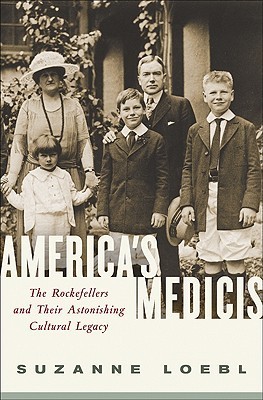
Book Review: America’s Medicis: the Rockefellers and Their Astonishing Cultural Legacy (five out of five stars)
A very interesting & well-written book. As long as you know what you’re getting into, it should be a very interesting read. It doesn’t cover the Rockefellers’ philanthropy outside of arts & culture, e.g. underwriting the University of Chicago and Rockefeller University in NYC. But it does cover an impressive variety of cultural projects and institutions that the Rockefellers either bankrolled completely or for which they provided very significant financial support, including Riverside Church, the Oriental Institute at the U of Chicago, ancient artifacts at the Met Museum in NY, Rockefeller Center (a huge story in itself and included here mainly because of its many artistic elements and controversies), the Museum of Modern Art, The Cloisters, Colonial Williamsburg, and the artistic elements of the Rockefeller estate on the Hudson, Kykuit.
The sections that were most interesting to me were:
- Abby Aldrich Rockefeller’s pivotal role in the creation of the Museum of Modern Art, despite her husband John Jr., with his much more conservative taste in art, raising many an eyebrow but never vetoing the purchases of now-famous works by Picasso, Matisse et al.
- Nelson’s strong interest in modern art and numerous initiatives showing that interest, despite having the personality of a stereotypical university fraternity brother or what we’d call a “frat bro” today. His artistic accomplishments including leading the MOMA through many sticky situations and creating the Empire State Mall in Albany, which apparently has always had its detractors but at a minimum showcased many cutting-edge artists.
- The partnership between John Jr. and James Rorimer in creating the Cloisters in its dramatic site at Fort Tryon Park overlooking the Hudson River at the highest point in Manhattan. As the book states, “Junior and Rorimer were perfectly suited to each other. Both were socially awkward, hardworking perfectionists who preferred work to play.” The story of how the famous Unicorn Tapestries (already owned by Junior) ended up in the Cloisters is interesting, since it involved a bit of subterfuge on the part of Rorimer.
I was struck in reading this book how much the Rockefellers loved art, wanted it around them and wanted to invest in both artists and US-based artistic institutions. To how many wealthy families, then or now, could this statement from the book be accurately applied? “Art had always been in important topic at the Rockefeller dinner table. Abby frequently hosted established artists such as Matisse and Rivera, and up-and-coming ones such as Arthur Davies and Charles Sheeler.”
 Heard and Seen Around Town
Leave a comment