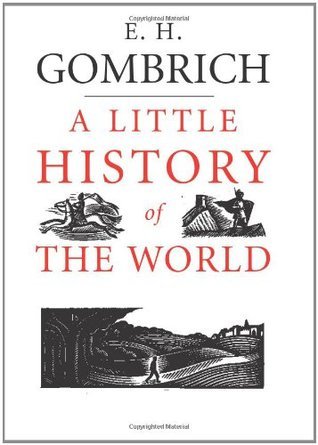
I can’t call this a fun read, given the sadly downbeat subject matter, but the book is educational, well-written, even elegant in its old-fashioned way, and you’ll probably sail through it quickly. Be aware that it’s intended for a young-adult audience. But this doesn’t really create a problem; in fact it helps the author distill the material to a relatively short (284 page) book.
Really the book should be called “My Little History of European Civilization”, because first of all, it focuses almost completely on European countries and their colonies – what used to be called Western Civilization I guess. You will only learn about Japan, China, Russia, and the Americas in the context of how they overlapped and (most often) clashed with European countries. So the “world history” moniker is a huge exaggeration, but cutting the author a little slack, he wrote almost all of this book close to 100 years ago. Now other historians of Gombrich’s stature should write similar short histories of the other major countries & zones of the world. (If they have, so much the better, but I’m not aware of these histories.)
Second, by the end the book is surprisingly personal. To understand this, you need to know that the first edition, including 39 of 40 chapters, was first published in German in 1936. The last chapter is much more personal than the rest of the book because it introduces the fact that the author was a young Austrian Jew in the mid-1930s, having escaped the Nazi empire and moved to London. He published the last chapter in the mid-1980s, bringing the history through WW2, the Holocaust, nuclear warfare & the fall of the Soviet empire. Naturally, since he lived through this tumultuous period, this chapter is more intense and personal than the rest of the book. Amazingly, he is able to depict the unfortunate events of the 20th century while also ending on a lyrical, elegant & at least somewhat upbeat note.
The best parts of the book cover when life was relatively simple for European peoples, e.g. the chapter “The Starry Night Begins”, which describes the early middle ages or “Dark Ages” under the “starry night” of Christian faith. To describe this era it’s not necessary to untangle and synthesize complex events such as the Hundred Years War, Industrial Revolution and the rise of labor movements and Marxism.
Later in the book, when describing these more complex events, Gombrich’s narrative-only approach starts to become a bit confusing because it’s missing (for me anyway) the lists, diagrams and even economic equations that might complement the text of these chapters in a formal history text. For example, although he includes a useful intro to Marx, I don’t believe he mentions Adam Smith or other founders of capitalism; nor does he offer an explanation of why capitalism may be more efficient at distributing products and resources than a Marxist economy with strict limits on private property.
I appreciated reading such a compressed & readable summary of European political and governmental history. I only remembered one phrase from my high school European history class: “the Hapsburgs and the Hohenzollerns”. Thanks to Gombrich I have a much fuller understanding of these two families and their importance – especially the Hapsburgs, whose influence seems to have been active for a much longer period.
His chapters on French history from Louis XIV (a more hardworking and organized monarch than I had thought) through the Napoleons were very well done & were actually page-turners with their extreme events and plot twists, ending with Napoleon exiled by the British (his most hated enemy) to far-off St. Helena in the middle of the Atlantic Ocean. Wow!
A mis-step (given recent scholarship) that may not have been completely the fault of Gombrich but more typical of the era when he wrote the book is that he describes the “Pilgrims” of Plymouth Plantation as traveling to Massachusetts in search of religious freedom. This was a convenient myth because it adds to their image of being pure and virtuous, and more importantly propped up the ruinous idea of the “Manifest Destiny” of the U.S. In fact, as discussed in Russell Shorto’s recent “Island in the Center of the World” (a history of the Dutch colonies in the US & primarily Manhattan), the group that became the “Pilgrims” had left England for the Netherlands in search of religious freedom. They found it in the Netherlands, whose people had become remarkably tolerant about religion after ridding themselves of their hated Spanish Catholic overseers. In fact, the “Pilgrims” may have left the Netherlands in part because it was too tolerant; they worried that their young folk would be lured away from the religion of their fathers. Certainly Massachusetts was a more isolated place where mind-control would be more achievable. But anyway, in Gombrich’s era this may not have been well known.
A highlight of the high quality Yale University Press paperback edition in English, published in 2005, is the frequent inclusion of beautiful illustrations (woodcuts?) by Clifford Harper.
 Heard and Seen Around Town
Leave a comment