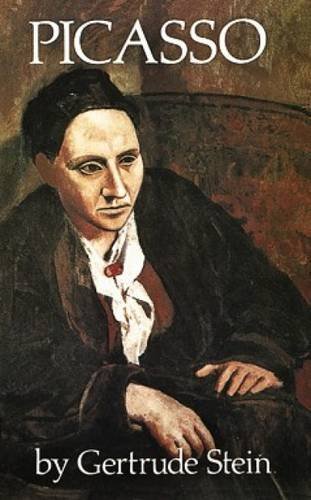
Book Review: Picasso by Gertrude Stein, published by B.T. Batsford Ltd., London 1938; reprinted by Dover Publications, New York 1984. (4 out of 5 stars)
It’s always fun to read reviews of Gertrude Stein’s books, for example on sites like GoodReads that publish reviews by the common rabble. She provokes a wide variety of reactions, including parodies, and many of them are very funny! I really enjoyed this book. But in order to enjoy it you need to, not to put too fine a point on it, cut Gertrude some slack. On the negative side, she had an over-inflated sense of her importance and even her own “genius”. She was a bit arrogant and certainly opinionated! She was a “legend in her own mind”. (In the Autobiography of Alice B. Toklas, which was actually written by Stein, she reports that someone told her he had met three geniuses in his life: Picasso, Gertrude and Andre Gide. Stein’s reaction? “Why include Gide?”)
But Gertrude also had a funny & self-deprecating side. She knew she was pushing the envelope with her prose style experiments and unwillingness to ever cut or revise. (Actually, this book and the “Autobiography” are relatively tame in terms of experimentation.) She had a good laugh when she saw American newspaper columnists making fun of her as her first books were published. And to be honest, re-reading the comment about Gide above, I suspect she was – in part! – pulling the questioner’s leg.
I think it’s best to think of Gertrude as your funny & cool lesbian aunt or great-aunt who lives in a cool city (Paris in her case) and, once you’re old enough to find it interesting, invites you for a fun and eye-opening visit. Yes, she says things that are over the top and generalizes left and right (Spanish are all like this, Americans are all like that, French are…) but she’s also smart and funny and let’s face it, you’re glad that she’s your aunt even if you do roll your eyes at some things she says. Aunt Gertrude! You can’t say that!!
In addition, she did spend a LOT OF TIME with several artists and writers who were soon to become very famous, and even influenced them in some cases (Picasso & Hemingway at a minimum). So one should take this book with a grain of salt. By no means is it an unimpeachable scholarly assessment of Picasso, but she does offer some very interesting and in some cases entertaining observations & stories. On top of this, how many scholars can say they were among the first buyers of Picasso, Matisse & others, and spent hundreds of hours with them?
Here are some of my favorite snippets from the book:
“His friends in Paris were writers rather than painters, why have painters for friends when he could paint as he could paint?” (a cockeyed statement but it’s true that Picasso gained inspiration from knowing non-painters like Apollinaire, Max Jacob & others)
“I was alone at this time understanding him, perhaps because I was doing the same thing in literature” (if you say so, Gertrude!)
“the cubism of 1913 to 1917 revealed the art of calligraphy to him, the importance of calligraphy as Orientals see it and not as Europeans see it” (a perceptive observation)
“The surrealists still see things as everyone sees them, they complicate them in a different way but the vision is that of everyone else, in short the complication is the complication of the 20th century but the vision is that of the 19th century. Picasso … sees something else, another reality.”
(Again, a perceptive & thought-provoking observation. I think she means that, for example, in a surrealist painting like Dali’s “The Persistence of Memory”, much of the painting – especially the background – is rendered in a realistic manner. It’s mainly the watches/clocks that appear to be made of liquid. So the clocks have “the complication of the 20th century”. By contrast, in a Picasso or Braque cubist painting, typically everything in the painting is rendered in a “cockeyed” manner with traditional perspective thrown out the window. The whole painting is depicting “another reality”. )
“the egoism of a painter is not at all the egoism of a writer, there is nothing to say about it, it is not. No.” (eye-roll….. the type of pronouncement that only a person who is a legend in their own mind could make – LOL)
In short, if you accept Gertrude Stein for what she is and surf over the book without being picky, it’s both interesting and entertaining. Where else can you read the story that Picasso’s apartment was burglarized at one point but the burglars took only linens and other odds and ends, leaving the paintings behind?
 Heard and Seen Around Town
Leave a comment