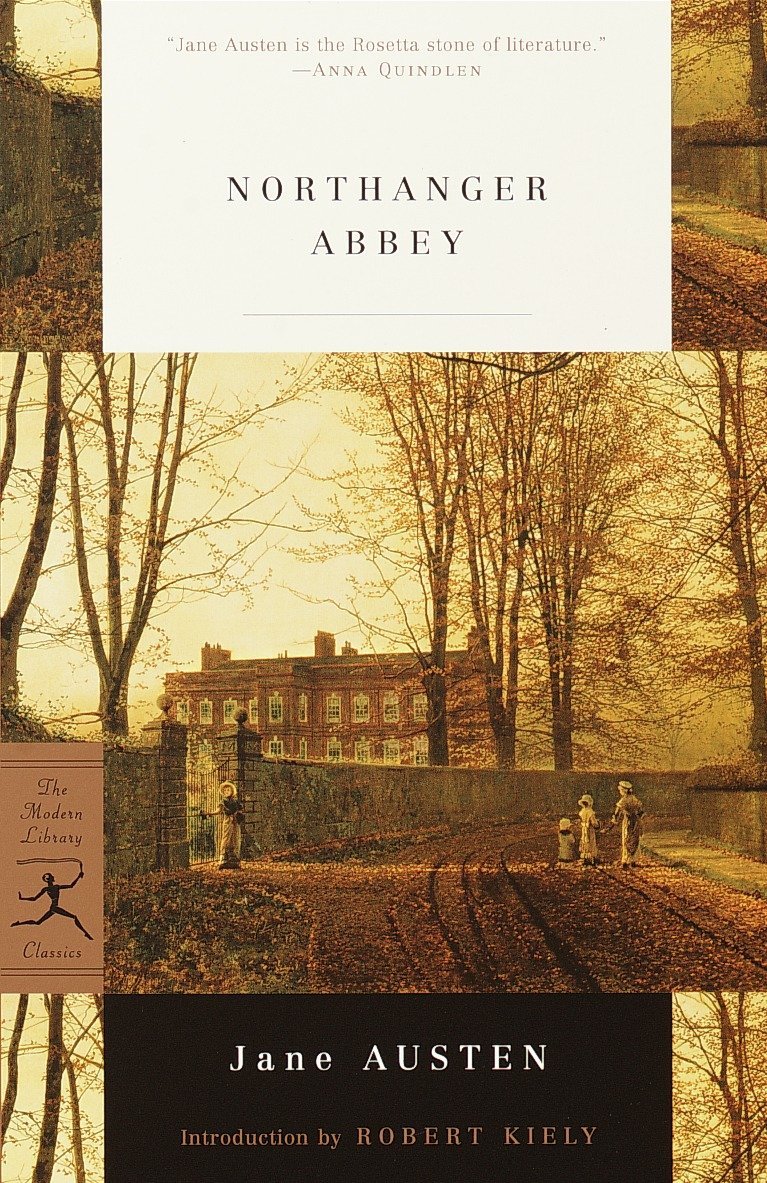
Book Review: Northanger Abbey by Jane Austen, published by Modern Library (Random House), New York, 2002. (5 out of 5 stars).
This novel was the first written by Austen (around 1803 when she was 28) but was not published until 1817, after her death, so she likely didn’t pick the title – I’m not sure on that detail. To me the title is not very compelling – it doesn’t make me curious about the book or want to read it. I have two other complaints about it: first, the Abbey doesn’t play that critical a role in the book overall – plenty of chapters, especially pivotal early ones, don’t take place there; and second, let’s face it, people are far more important in a novel than buildings. Jane Eyre, for example, is not called Thornfield Hall. Yes, Wuthering Heights is the name of a house but that house is way more critical to the novel than Northanger Abbey is to this novel.
So, in appreciation for Austen’s clever habit of naming her novels “Noun and Noun”, for example Pride and Prejudice and Sense and Sensibility, I tried my hand at it. I kind of like my Innocence and Impecuniousness because it’s laughably bad. Miss Austen would likely say, I hope with a wink, “I appreciate your attempt Mr. Thomson but it is, to put it charitably, infelicitous.”
How did I pick the two words? “Innocence” is fitting because Catherine Moreland, the novel’s protagonist, is a naive & innocent 17 year old who gains important life experience during the novel. For the second word, needing another word beginning with “I”, I tried “Idiosyncrasy”, because many of the characters have noticeable idiosyncrasies. To mention two, Mrs. Allen is hilariously obsessed with fashion and clothing, while Catherine’s cringey would-be-suitor John Thorpe is hilariously obsessed with horses, carriages and their associated equipment. Once I finished the book, however, I decided my second noun had to relate to money, since money (especially of the dowry and future income variety) is critical to the plot and, unfortunately, to the lives of each character.
So I’ll stick with Innocence and Impecuniousness!
Anyway, despite being one of Austen’s less popular novels, Northanger Abbey is a wonderful book. It’s clever and funny, has compelling and (as I mentioned) idiosyncratic characters, an entertaining plot, plenty of romance, and in the bargain contains a hilarious send-up of the popular “Gothic” novels of Austen’s time, notably Ann Radcliffe’s Mysteries of Udolpho. Specifically, it’s not so much a send-up of the novels – which, being very popular, after all achieved their goal of entertaining thousands of readers. It’s more a send-up of the Gothic novel readers themselves and how their imaginations could hilariously run wild.
I won’t attempt to summarize the plot here; you can easily find a summary online and I don’t want to drop any spoilers.
Instead, I’d like to emphasize certain things I really liked about the novel, with a few minor complaints tossed in, since I didn’t love everything.
The first thing I want to mention is that, speaking as an English major from decades ago, I feel that I have achieved an important milestone. Given that Austen’s novels are among the famous, revered and very much enjoyed cornerstones of English language literature, I have filled a glaring gap. I finally finished, read carefully, and enjoyed a Jane Austen novel! In my college/university days I was assigned Emma as part of a survey class (it might have been called English Literature II, I don’t recall), but I’ll bet I skimmed it, not having enough time to do it justice. I’m sure I didn’t read every word or have time to appreciate it.
In addition, I have always had trouble with Austen novels (notably Pride and Prejudice) and even the movies, for two reasons. First, the language can be gnarly, i.e. long sentences, elaborate syntax, and somewhat antiquated word choices. Of course, as English majors we’re supposed to enjoy the gnarly, tricky sentences and become good at wading through them. This is true to a point, but I find it can also be exhausting and, I admit, a bit boring. Second, I have trouble keeping characters straight when there are many similar ones, e.g. several daughters in one family. Then they start speaking to each other and I’m often not sure which one is speaking.
Northanger Abbey has the advantage of having fewer important characters than other Austen novels like Pride and Prejudice, and – critical for an impatient reader – being a bit shorter than the more famous Austen novels.
So I’m feeling good knowing that I found an Austen novel that I truly enjoyed and can wholeheartedly recommend!
In terms of what I liked most, I’ll focus on Austen’s clever spoof of Gothic fiction and readers, which takes up at least the middle third of the book.
Catherine Moreland is a big fan of Gothic novels like those of Ann Radcliffe, so when she’s invited to visit the country home of her crush’s family, which happens to be a former Abbey dating back to before the Dissolution of the Monasteries under Henry VIII, she’s very excited and her imagination runs wild at the possibilities, e.g. abandoned corridors, haunted rooms, chests with secret compartments, ghastly rumored crimes from two hundred years ago, and so on.
In Austen’s skillful hands, this creates plenty of both comedy and romance. Catherine’s crush, Henry Tilney, clearly is very fond of her but they barely know each other when they arrive at the Abbey. He’s very articulate and has the gift of gab (he’s got game to use the current term), so he realizes that he can indulge her mania for Gothic tales and enjoy plenty of teasing banter by spinning out elaborate word pictures. In fact, the funniest sequence in a novel with plenty of funny parts is probably the following, when Henry, after telling Catherine that he spends much of his time in his parsonage a few miles away, starts to describe the abbey and Austen starts her spoof of the Gothic. I especially love Catherine’s reactions – first shocked and then breathlessly wanting him to keep going. It’s easy to imagine that Henry is having trouble keeping a straight face!
‘You must be so fond of the abbey! After being used to such a home as the abbey, an ordinary parsonage-house must be very disagreeable.’
He smiled, and said, ‘You have formed a very favourable idea of the abbey.’
‘To be sure, I have. Is not it a fine old place, just like what one reads about?’
‘And are you prepared to encounter all the horrors that a building such as ‘what one reads about’ may produce? Have you a stout heart? Nerves fit for sliding panels and tapestry?’
‘Oh! yes – I do not think I should be easily frightened, because there would be so many people in the house – and besides, it has never been uninhabited and left deserted for years, and then the family come back to it unawares, without giving any notice, as generally happens.’
‘No, certainly. We shall not have to explore our way into a hall dimly lighted by the expiring embers of a wood fire – nor be obliged to spread our beds on the floor of a room without windows, doors, or furniture. But you must be aware that when a young lady is (by whatever means) introduced into a dwelling of this kind, she is always lodged apart from the rest of the family. While they snugly repair to their own end of the house, she is formally conducted by Dorothy, the ancient housekeeper, up a different staircase, and along many gloomy passages, into an apartment never used since some cousin or kin died in it about twenty years before. Can you stand such a ceremony as this? Will not your mind misgive you when you find yourself in this gloomy chamber – too lofty and extensive for you, with only the feeble rays of a single lamp to take in its size – its walls hung with tapestry exhibiting figures as large as life, and the bed, of dark green stuff or purple velvet, presenting even a funereal appearance? Will not your heart sink within you?’
‘Oh! But this will not happen to me, I am sure.’
‘How fearfully will you examine the furniture of your apartment! And what will you discern? Not tables, toilettes, wardrobes, or drawers, but on one side perhaps the remains of a broken lute, on the other a ponderous chest which no efforts can open, and over the fireplace the portrait of some handsome warrior, whose features will so incomprehensibly strike you, that you will not be able to withdraw your eyes from it. Dorothy, meanwhile, no less struck by your appearance, gazes on you in great agitation, and drops a few unintelligible hints. To raise your spirits, moreover, she gives you reason to suppose that the part of the abbey you inhabit is undoubtedly haunted, and informs you that you will not have a single domestic within call. With this parting cordial she curtsies off – you listen to the sound of her receding footsteps as long as the last echo can reach you – and when, with fainting spirits, you attempt to fasten your door, you discover, with increased alarm, that it has no lock.’
‘Oh! Mr. Tilney, how frightful! This is just like a book! But it cannot really happen to me. I am sure your housekeeper is not really Dorothy. Well, what then?’
‘Nothing further to alarm perhaps may occur the first night. After surmounting your unconquerable horror of the bed, you will retire to rest, and get a few hours’ unquiet slumber. But on the second, or at farthest the third night after your arrival, you will probably have a violent storm. Peals of thunder so loud as to seem to shake the edifice to its foundation will roll round the neighbouring mountains – and during the frightful gusts of wind which accompany it, you will probably think you discern (for your lamp is not extinguished) one part of the hanging more violently agitated than the rest. Unable of course to repress your curiosity in so favourable a moment for indulging it, you will instantly arise, and throwing your dressing-gown around you, proceed to examine this mystery. After a very short search, you will discover a division in the tapestry so artfully constructed as to defy the minutest inspection, and on opening it, a door will immediately appear – which door, being only secured by massy bars and a padlock, you will, after a few efforts, succeed in opening – and, with your lamp in your hand, will pass through it into a small vaulted room.’
‘No, indeed; I should be too much frightened to do any such thing.’
‘What! Not when Dorothy has given you to understand that there is a secret subterraneous communication between your apartment and the chapel of St. Anthony, scarcely two miles off? Could you shrink from so simple an adventure? No, no, you will proceed into this small vaulted room, and through this into several others, without perceiving anything very remarkable in either. In one perhaps there may be a dagger, in another a few drops of blood, and in a third the remains of some instrument of torture; but there being nothing in all this out of the common way, and your lamp being nearly exhausted, you will return towards your own apartment. In repassing through the small vaulted room, however, your eyes will be attracted towards a large, old-fashioned cabinet of ebony and gold, which, though narrowly examining the furniture before, you had passed unnoticed. Impelled by an irresistible presentiment, you will eagerly advance to it, unlock its folding doors, and search into every drawer – but for some time without discovering anything of importance – perhaps nothing but a considerable hoard of diamonds. At last, however, by touching a secret spring, an inner compartment will open – a roll of paper appears – you seize it – it contains many sheets of manuscript – you hasten with the precious treasure into your own chamber, but scarcely have you been able to decipher ‘Oh! Thou – whomsoever thou mayst be, into whose hands these memoirs of the wretched Matilda may fall’ – when your lamp suddenly expires in the socket, and leaves you in total darkness.’
‘Oh! No, no – do not say so. Well, go on.’
But Henry was too much amused by the interest he had raised to be able to carry it farther; he could no longer command solemnity either of subject or voice, and was obliged to entreat her to use her own fancy in the perusal of Matilda’s woes.
This section has so many great parts:
“uninhabited and left deserted for years, and then the family come back to it unawares”!
The broken lute!
The “apartment never used since some cousin or kin died in it about twenty years before”!
Dorothy, who “gives you reason to suppose that the part of the abbey you inhabit is undoubtedly haunted, and informs you that you will not have a single domestic within call”, and “with this parting cordial, curtsies off”… !
The “division in the tapestry so artfully constructed as to defy the minutest inspection”!
The “secret subterraneous communication between your apartment and the chapel of St. Anthony”. Scarcely two miles off!
The “remains of some instrument of torture”!
Discovering nothing of importance in the cabinet except perhaps “a considerable hoard of diamonds”!
The memoirs of the wretched Matilda!
The lamp expiring, “leaving you in total darkness”!
And finally, Catherine’s comical indecision about hearing more: ‘Oh! No, no – do not say so. Well, go on.’
Austen’s writing is so great, seemingly effortless and funny in this passage that it reminds me of similar virtuosos like Charlie Parker in jazz or Yuja Wang in classical music. And Austen was only in her twenties when she wrote it. Wow!
It also reminds me of a spooky experience I had during a business trip to Hyderabad, India many years ago. During some of my spare time, a young lady on our team, Harini, took me to a local tourist site, the Qutb Shahi tombs which date back to between 1500 and 1700. It’s a solemn, out of the way site with many crumbling tomb buildings surrounded by ill-maintained tufts of grass. On that day it was almost deserted. A forlorn-looking woman was stoically trying to sell cucumbers to the well-nigh-nonexistent visitors. We went into one of the buildings through an open door. It was dark and silent in there, with rough limestone walls extending high up toward puny, dirty openings that allowed very little light to enter. I could hardly see Harini but I could tell she was wide-eyed and looking startled. She whispered: “if we were shut in here I would die of fright itself.”
Getting back to the book, not only is the Gothic spoof very funny. Austen also cleverly uses it in the service of something completely different, a comedy of manners romantic plot. Henry teases Catherine with his story, confirming that he likes her a lot. He likes to pay attention to her and entertain her, and Catherine eats it up.
Soon after, Catherine concocts another variation on the Gothic theme, this time a theory about none other than Henry’s mother and father. It turns out to be complete rubbish. But she learns a lesson from her foolishness and in the process, her love for Henry increases.
Then there’s one more twist on the Gothic, this time for real and causing Catherine to be suddenly cast out of the Abbey for a mysterious reason. She has to leave early the next morning and travel by carriage, unescorted, seventy miles back to her parents’ home in Fullerton. But this sets the stage for a romantic and happy end to the novel.
I do have some complaints about the book, but they’re minor and one is anachronistic.
First, once Catherine and Henry are together at the Abbey, the minor characters – who are each engaging and intriguing – completely fall away and we hear almost nothing more about them. I’d like to know more about what happened to the hilarious John Thorpe, Catherine’s virtuous and ill-treated brother James, her friend Isabella Thorpe who was a bit too preoccupied with money, Henry’s intelligent and endearing sister Eleanor, and so on. It would have been nice to at least have a wedding scene at the end that would bring these characters together and further illustrate their characters. Perhaps an opportunity for fan fiction!
Second, and this is anachronistic I suppose, Catherine and Henry seem like a couple who will likely have a happy life together with plenty of fun, but their relationship is very patriarchal: Henry can be pedantic and patronizing, and sometimes seems more like her father or older brother than a soulmate. It’d be nice to see more humility on his part and feistiness on hers that would suggest a more equal partnership going into the future. But then again, she’s only seventeen years old in the novel! Again, an opportunity for fan fiction. (By the way, you can find here just one of the many archives of Northanger Abbey fan fiction.)
Overall though, I thoroughly enjoyed the book and in the bargain, feel like I have shored up my English major credentials a little. Now the question is, will I ever actually read all of Ulysses or the Canterbury Tales? (Doubtful.)
But there’s another reason, specific to Northanger Abbey, why I’m feeling relieved. In an often-quoted statement, none other than the novel’s romantic hero, Henry Tilney, says the following about those who don’t enjoy fiction!
The person, be it gentleman or lady, who has not pleasure in a good novel, must be intolerably stupid.
 Heard and Seen Around Town
Leave a comment