
Book Review: American Women of Achievement: Phillis Wheatley by Merle Richmond, published by Chelsea House Publishers, New York, 1988. (5 out of 5 stars).
Imagination! who can sing thy force?
Or who describe the swiftness of thy course?
Soaring through air to find the bright abode,
Th’empyreal palace of the thund’ring God,
We on thy pinions can surpass the wind,
And leave the rolling universe behind:
From star to star the mental optics rove,
Measure the skies, and range the realms above.
There in one view we grasp the mighty whole,
Or with new worlds amaze th’unbounded soul.
The above is from the poem “Imagination”, published in Poems on Various Subjects, Religious and Moral by Phillis Wheatley in 1773, when Wheatley was only 20 years old. When the book was published in London, Wheatley became the first African American and first enslaved person in the colonies to publish a book of poems. Because of this, she is considered to be the mother of Black American literature.
In her early 20s Wheatley was a local celebrity in New England. Her skills as a poet were well known among the elite of Boston. She took the initiative to write to General George Washington in October 1775, sending him a poem she had written about him. He was very busy of course, since the Revolutionary War had just started earlier that year with the Lexington & Concord incident. Nonetheless, in February 1776 he sent her a reply thanking her for the poem, and said that “if you should ever come to Cambridge, or near headquarters, I shall be happy to see a person so favored by the Muses, and to whom nature has been so beneficent in her dispensations.” Reading this from a modern perspective, we can be tempted to focus on his very formal language, but of course in the 18th century – and especially in official circles like Washington’s – this language was not at all unusual. What was unusual was that Washington was, likely for the first time, inviting a black woman to pay him a social visit. Historical sources indicate that Washington spent 30 minutes with his visitor. After the meeting, Wheatley wrote a 42-line poem in tribute to Washington. The final lines give a flavor of this poem:
Proceed, great chief, with virtue on thy side,
Thy ev’ry action let the Goddess guide.
A crown, a mansion, and a throne that shine,
With gold unfading, WASHINGTON! Be thine.
Soon after, the poem was published in Pennsylvania Magazine by now-famous editor Thomas Paine.
I bought this short biography by Merle Richmond in a used bookstore recently. It caught my eye because as long as I can remember, I have been aware that a Phyllis Wheatley Community Center existed in my hometown of Minneapolis. I always thought “that name is a bit interesting and unusual”, but I never knew where it came from. In fact, after buying the book I thought that the community center must have long since faded away, because I never hear about it; so I was surprised and pleased to find that it is still completely alive and functioning on the North Side of Minneapolis.
I highly recommend the book because Wheatley turns out to be a fascinating historical figure whose story is remarkable and poignant. She lived in Boston at a tremendously dramatic time – before and after the Revolution. Despite being a young enslaved person at the time, her life touched those of more than one Founding Father. Her poetry seems almost ancient, but if you give it a chance, it’s still very powerful. And yet her story still has resonance in our time.
The book is actually intended for young adults and is quite short, but that’s actually an advantage for a couple reasons. First, not much is known about Wheatley in the first place. Second, some recent accounts add interpretations, opinions and even creative contributions like original poetry that may not be the best starting point for learning about Wheatley. If you’re interested but can’t find Richmond’s book, just read the Wikipedia page on Wheatley and then a few articles that you can find through web searching, such as those linked below.
Frequently when I read about historical figures, I’m reminded that as 21st century, relatively privileged humans, we walk in the footsteps of giants, people who met and conquered challenges that from the modern perspective are bizarre, astonishing and downright head-exploding. And sometimes we walk the same streets they walked on. Of course, admittedly it helps to live in, or visit, a historic city like Boston.
If you ever have the chance to walk down Boston’s Commonwealth Avenue – and I highly recommend you do – you’ll find it’s a beautiful boulevard with grass and gardens planted between bustling lanes of traffic near the Public Garden, Boston Common and, up on Beacon Hill, the gold-domed State House (capitol building). When you take this walk, between Fairfield and Gloucester Streets you’ll certainly see the Boston Women’s Memorial, which includes the Phillis Wheatley memorial sculpture shown in the photo below and well described in this article published by “Historic Boston”. Certainly Phillis Wheatley, in her quiet way, unknown to all but a few passersby, was one of those giants whose footsteps we walk in.
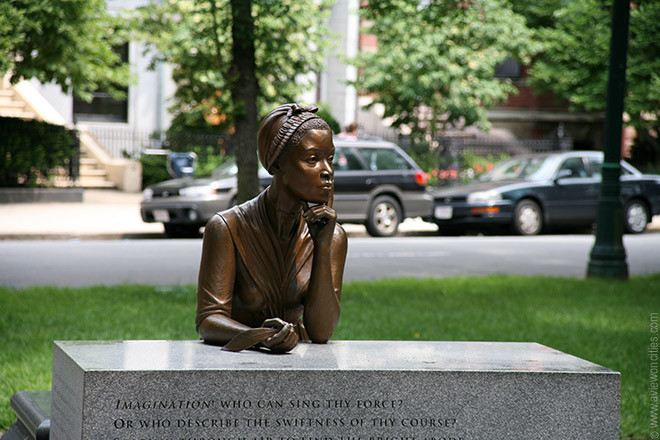
Phillis Wheatley was born in current Senegal or Gambia (West Africa). She was kidnapped before the age of ten and sold into slavery. When she arrived in Boston in 1761, she was sickly, underweight and, we learn from an early biographer quoted in Richmond’s book, “adjudged to be seven or eight years, from the circumstance of shedding her front teeth.” She was sold to Susannah Wheatley, the wife of a prominent Boston merchant. Susannah was over fifty and her two children, 18-year-old twins Mary and Nathaniel, would soon be getting married and leaving the house. Susannah planned that the young girl, “procured for a trifle”, would be her personal servant in her old age. The girl was given the family surname, as was a common practice. In what seems a cruel irony, for a first name she was not given a Christian name but instead named after the slave ship she arrived on, the Phillis. So from that day forward, she had to carry the name [slave ship I arrived on] [my slave-owning family], with no vestige of a birth name.
Historians estimate that when Wheatley arrived in Boston there were about 230,000 Africans living in the U.S., but only about 16,000 in New England. The vast majority were in the South, mostly working in the agricultural economy. There were laws in the South that prohibited enslaved persons from owning property or defending themselves against abuse by their owners.
The situation in New England was slightly different. Enslaved persons were mostly domestic servants there, since the agricultural economy was much smaller. Laws regarding slavery were also slightly less onerous in New England than in the South.
It’s hard to imagine what it must have been like for Wheatley to be taken through the streets of Boston to her new home in one of the finest mansions in the city. The author provides a vivid description:
“The African child must have felt bewildered and afraid. The streets were crowded with people of many different colors and appearances. Most of them were white, but some were black and others brown. There were seamen smartly outfitted in British, French or Spanish uniforms. They strolled near the docks, mingling with roughly dressed sailors and deckhands. The economy of Boston was based on the sea, and the city’s air was filled with the aroma of fresh fish carried by the breeze blowing from the harbor. Phillis Wheatley saw men in waistcoats, knee breeches, and white-powdered wigs, striding along with an important air. Strolling past shop windows were women wearing long, full skirts; some were trailed by servants laden with packages. Roving vendors proclaimed the virtues of their wares with loud calls and the ringing of hand bells. Others hawked their goods and services from waist-high wooden stalls. The air was filled with an array of mysterious smells: turpentine, spices, oranges, bananas and tea and coffee shipped to the colonies from England. Through the open doors and windows of taverns came the odors of rum, cooked food, pipe tobacco and beer.”
Suddenly Phillis’s fortunes changed drastically. She was treated well by the Wheatleys. The family quickly realized that Phillis was a quick learner, and to their credit, they encouraged her to become literate. Their encouragement of the young African girl’s intellectual development would have been punishable by law in southern states. 18-year-old Mary was assigned to be Phillis’s tutor. By age nine, sixteen months after arriving from Africa, Phillis could not only read English but could understand some of the most difficult passages in the Bible. Her literacy already surpassed that of many adults in New England.
To their credit, the Wheatleys didn’t respond to Phillis’s precocious intellect by scaling back her learning and bringing her back to a more conventional “lady’s maid” role. Instead they doubled down on Phillis’s development. She began regularly writing poems around the age of 12, and the family’s treatment of her was nothing if not remarkable for a young enslaved person. Two examples show this:
First, the family’s accommodations for her writing: “they now allowed her to keep a candle burning in her room all night in case she needed light by which to compose verse.” (Side note, this sounds a bit dangerous, but be that as it may.). “They also placed paper, a bottle of ink, and a quill on her nightstand; on cold nights, they made sure the fireplace in her quarters was kept burning. It is safe to assume that the Wheatley home was the only one where a slave greeted her masters in the morning with poems she had written during the night.”
Second, how the family treated her compared with other household servants: “One day, while Phillis was visiting at the home of another Boston family, the weather suddenly turned cold and damp. Fearing for the young woman’s delicate health, Susannah Wheatley sent Prince [a household servant] to fetch her in the family carriage. When the carriage returned to the Wheatley mansion, Phillis was seated up front in the driver’s seat with Prince. Furious, Susannah Wheatley rebuked him for his ‘impudence’ in seating Phillis with himself instead of inside the carriage, where a person of higher rank belonged. A modern reader can only guess how Phillis Wheatley felt about this matter, but it is likely that she would have enjoyed forming some human attachments. In any case, on that cold and bleak day, Susannah Wheatley made it clear that ‘her Phillis’ was not to associate on friendly, equal terms with other blacks. Phillis Wheatley’s writings offer no clue as to whether her opinion of herself was as high as that of her mistress.”
Of course, this well-intentioned separation of Phillis from other Blacks and servants put Phillis in a difficult position. Maybe the Wheatleys were unaware of this or unable to find a way to handle it. But as we’ll see, being “stuck in the middle” continued to create problems for Phillis. Eventually, and sooner than she probably expected, she had to decide between a (possibly) elite life as a celebrated writer – in England no less – and life in the Black community of Boston.
Before getting into this stark and fateful decision, though, I should explain a little more about why Wheatley became noticed and celebrated. She really was a remarkably precocious and skilled poet. The Wheatleys must have quickly realized that Phillis was, in verbal terms at least, likely by far the most intellectually capable person in the household, and uncommonly focused and organized as well. (Her penmanship alone is elegant and beautiful.)
Wheatley’s poetry can seem strange and overly formal to the modern reader, so in order to appreciate it more, let’s take a brief step back and put it in context.
In the 18th century when Wheatley was writing, poetry was much different than it is today. It was called the “Augustan” era, a few years before the “Romantic” movement, which included young writers like Byron, Keats, Coleridge, Shelley and Wordsworth, started injecting strong personal feelings and dramatic stories into poetry. Young Phillis Wheatley modeled her poetry on writers like Alexander Pope, who wrote careful, formal poetry using long-established forms like the heroic couplet, which is a pair of rhymed lines written in “iambic pentameter”, like the lines from Wheatley’s poem about Washington. (Accented syllables are capitalized)
ProCEED great CHIEF with VIRtue ON thy SIDE
Thy EV’ry ACtion LET the GODdess GUIDE
This careful, structured approach to poetry is also reminiscent of musical artists like Mozart, who lived at the same time as Wheatley and generally wrote (to modern ears anyway) very careful, structured music.
Side note: at first I wondered who Wheatley meant when she used the word “goddess”. According to one interpretation it was Libertas, the ancient Roman goddess of Freedom.
Anyway, my point is not that we should be wild about 20-year-old Wheatley’s controlled, erudite, carefully crafted, rule-following, 250-year-old poetry, which is so radically different from what modern audiences think of as poetry, but that we should appreciate the remarkable skill and talent that went into it, especially coming from a person who had emerged from a slave ship into Boston, not speaking a word of English, at age 7.
With this background in place we can take a look at the remarkable, eventful but also tragic 14-year chain of events that included writing the poems that are still known today, reaching the peak of her fame, and her tragic death at just 31.
1770 – At age 17 Wheatley became locally famous for her poem “An Elegiac Poem On the Death of that celebrated Divine, and eminent Servant of Jesus Christ, the Reverend and Learned Mr. George Whitefield”. Whitefield was a renowned British preacher associated with the “Great Awakening”. Whitefield, who was “said to be capable of reducing his listeners to tears merely by saying the word ‘Mesopotamia’”, emphasized that “people of all colors were spiritual equals” and introduced the idea that “it was sinful for the white man to enslave his black brother, who also had an immortal soul”. Not surprisingly, Wheatley was highly inspired by Rev. Whitefield, and was a devout Christian throughout her adult life.
1772 – Susannah Wheatley and Phillis were trying to find a publisher for a set of Phillis’s poems. They needed to prove that Phillis was indeed capable of writing such poems. They arranged for eighteen “Worthies of Boston” (elite white men such as John Hancock) to interview Wheatley. They came away convinced that she was the author that she claimed to be. They provided an attestation “To the PUBLICK” stating that the poems were indeed “written by Phillis, a young Negro girl, who was but a few years since, brought an uncultivated barbarian, from Africa, and has ever since been, and now is, under the disadvantage of serving as a slave in a family in this town”.
1773 – Given an opportunity to publish the book in London under the sponsorship of the abolitionist Countess of Huntingdon, Phillis traveled with Susannah’s son Nathaniel to England. The book, Poems on Various Subjects, Religious and Moral, was published in London in September. Phillis’s increasing fame led to calls from abolitionists, especially in London, that she be freed (the official term is “manumitted”), and by the end of the year Phillis was back in Boston and technically a free woman, though she continued to live with the Wheatleys.
1774 – Wheatley began promoting and selling her now-published book in the Boston area. She also received an offer to move to England. John Thornton, a wealthy member of the Countess of Huntingdon’s religious circle, offered to take over Susannah Wheatley’s role as Phillis’s patron and spiritual mentor. In a strange twist, Thornton the offer included – or perhaps would have required? – the opportunity to become a Christian missionary in Africa. Phillis had to make a critical decision: accept Thornton’s offer or pursue an (eventually) independent life in Boston. Adding to the urgency of Phillis’s decision, Susanna Wheatley died. Phillis, who by this time had some friends in the Black community around Boston and didn’t want to once again be the protégée of an elite white person, decided to pass up Thornton’s offer.
1775 – As described above, Wheatley met with General Washington at his Cambridge headquarters and published her poem about Washington.
1778 – John Wheatley died. I found no information in Richmond’s book or elsewhere suggesting that the surviving family members, twins Nathaniel and Mary, continued a sibling-like relationship with Phillis or supported her in any way. I find this disturbing and disappointing. Phillis was apparently now on her own, attempting to support herself in the post-revolutionary world of the new United States. She had known a local free Black grocer, John Peters, for several years, and during this year they were married.
1779 to 1784 – Phillis became the mother of three children, but none of them survived to adulthood. John Peters had some success as a grocer, but his debts accumulated during this period and by September 1784 he was in debtor’s prison. Phillis, the once internationally famous poet who eleven years earlier had been presented a valuable edition of English poet John Milton’s “Paradise Lost” by the Lord Mayor of London, now was on her own with a sickly infant son to provide for. She “became a scullery maid at a boarding house, doing work she had never done before; she developed pneumonia and died on December 5th, 1784 at the age of 31, after giving birth to a daughter, who died the same day.”
Phillis Wheatley is said to have been buried in an unmarked grave in Copp’s Hill Burying Ground in Boston, in the North End near the Old North Church.
Pondering Wheatley’s great achievements in contrast to her later struggles, untimely death and burial in an unmarked grave would be a very sad note on which to end this review. Fortunately, I found a story from our own time that’s much more upbeat. First, though, we need to consider another of the Founding Fathers.
All of them were presumably racist in different degrees, but George Washington comes out of this story seeming relatively redeemable. He responded to Wheatley’s letter with a respectful letter addressing her as “Miss Phillis”, which is described as “an unusually polite way for a member of the gentry to address an enslaved person.” He took the time to meet with her in Cambridge. He left instructions in his will to emancipate the people enslaved by him (or whom he had inherited in an enslaved status), upon the death of Martha Washington.
In contrast, consider Thomas Jefferson, who enslaved far more people than Washington, is documented to have ordered physical punishment of enslaved persons, and has been proven by DNA evidence to have fathered children with Sally Hemings, a Black woman who was one of his personal attendants. The same New York Times article states that despite rumors and pending DNA testing, it appears unlikely that Washington fathered any children whose mothers were enslaved. Finally, Jefferson freed at most 10 of his up to 600 enslaved persons, either during his lifetime or via his will.
Why this digression about Jefferson? In keeping with the image suggested above, Jefferson wrote this about Wheatley in his “Notes on the State of Virginia”, not even taking care to spell her either of her names correctly:
“Religion indeed has produced a Phyllis Whately [sic]; but it could not produce a poet. The compositions published under her name are below the dignity of criticism.”
After 23-year-old Amanda Gorman recited her stirring poem “The Hill We Climb” at President Biden’s inauguration in January 2021, to general excitement and acclaim, there were also nay-sayers whose comments recalled what Jefferson wrote about Wheatley. Minisha Sinha wrote a very interesting op-ed piece on CNN.com about the reactions to both of these young Black female poets.
Amanda Gorman herself, writing on Twitter (now ‘X’), retweeted Sinha’s summary of her article and added her own zinger:
“Whenever I feel unable to write, I remember that Thomas Jefferson singled out young black poetess Phillis Wheatley with shallow disdain: ‘Among the blacks is misery enough, God knows, but no poetry.’ Then I crack my knuckles and get to work.”
 Heard and Seen Around Town
Leave a comment