
My wife and I spent April 2024 in Venice, mostly to relax, soak up history and culture, and indulge in more than a few happy hours, mostly centered on drinking Aperol Spritzes and eating cicchetti, the ubiquitous, cheap and addictive Venetian appetizers. But in addition, we chose April in part because we could attend the Biennale di Arte, the huge contemporary art show Venice has held every two years since 1893, with only a few gaps (you can imagine the reasons, I won’t go there).
We really enjoyed the Biennale, so much that I decided to write about it in this blog. My Part 1 entry was about a year ago. In that entry you’ll find some background on the Biennale’s history, how it’s presented around Venice, and even my philosophy about what makes good and worthwhile art. So I won’t repeat any of that here.
Then six months ago in February, because the first entry was very general, briefly mentioning many many artists, at a friend’s request I wrote another post focused on just my favorite artist of the entire Biennale, Moufouli Bello.
Despite breaking my personal post-length record, my first Biennale post still didn’t cover everything I wanted to highlight about the 2024 Biennale, which is a nice problem to have because it means I got excited about a large set of artists who were previously unknown to me. I focused on the primary Biennale locations, the Arsenale and Giardini (Arsenal and Gardens), located on the east side of Venice and including the rather famous national pavilions representing many countries.
I didn’t write about two other important types of venues, where I also found artists whose works I wanted to share:
- A couple of interesting national pavilions that don’t happen to be located in the Giardini or Arsenale. In my first post I did write about one national pavilion outside the Arsenale+Giardini, the wonderful Nigerian Pavilion, but I want to highlight two more that could hardly be more contrasting: the tiny Panama pavilion and the large, highly publicized pavilion of the Holy See, i.e. the Vatican.
- “Collateral” Exhibitions, a catch-all term for exhibitions that were privately sponsored, usually by major art institutions like the Los Angeles County Museum of Art (LACMA) or commercial galleries, and make use of the seemingly endless supply of beautiful, often somewhat crumbling and likely underutilized palazzos (former palaces of rich Venetians) and similar sites that are available as event spaces.
So, in this post I’ll focus on the above two categories.
National Pavilions outside the Giardini & Arsenale
There weren’t very many of these. Most were located on the east side of Venice near the Giardini & Arsenale.
The tiny Panama national pavilion was located in a hole-in-the-wall space, about as big as a one-bedroom apartment, near the Arsenale. The small size was testament to those in Panama who were likely very limited in budget but had plenty of enthusiasm and found a way to present some exciting works. The artist that impressed me most was Brooke Alfaro. You can learn more about him at this site (you may want to click the button to translate Spanish to English text).
These two walls, showing Alfaro’s work, comprised about one-fourth of the entire Panama pavilion:
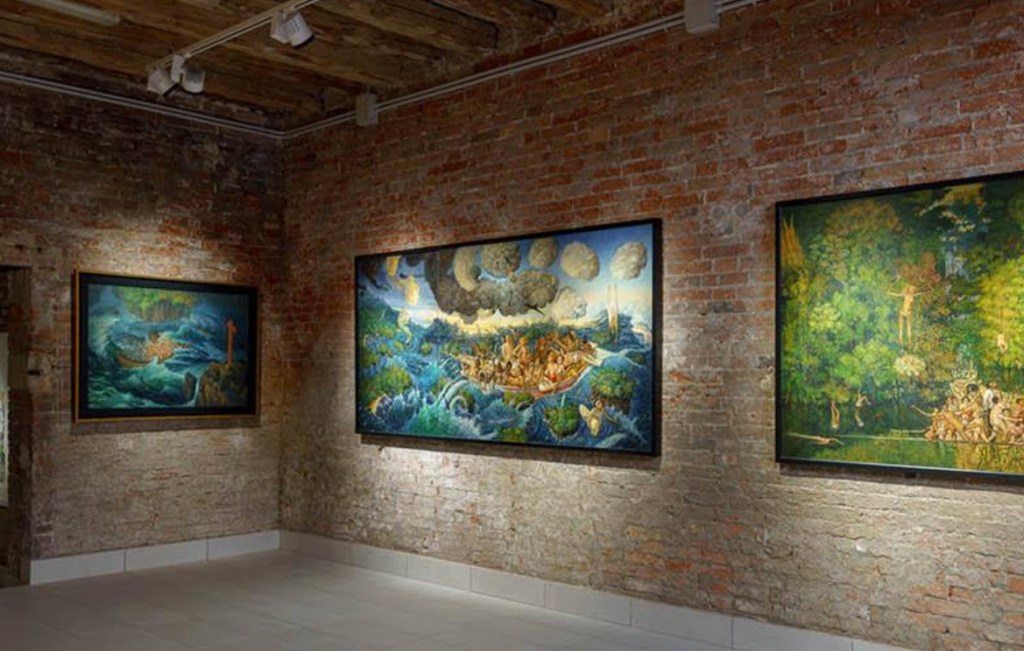
Alfaro, born in 1949, studied in his native Panama as well as the Art Students League in New York City, and is one of Panama’s most acclaimed artists. He is a social and environmental activist and this is reflected in his subject matter.
Many of his works have a “magical realist” quality with intense, sometimes distorted figures reminiscent of Bosch and, to a lesser extent, Bruegel. The image below is a detail from the middle painting above, and depicts migrants attempting to leave their home countries and migrate north to the US, Canada or similar destination. I also see echoes of Van Gogh in the swirling waves.

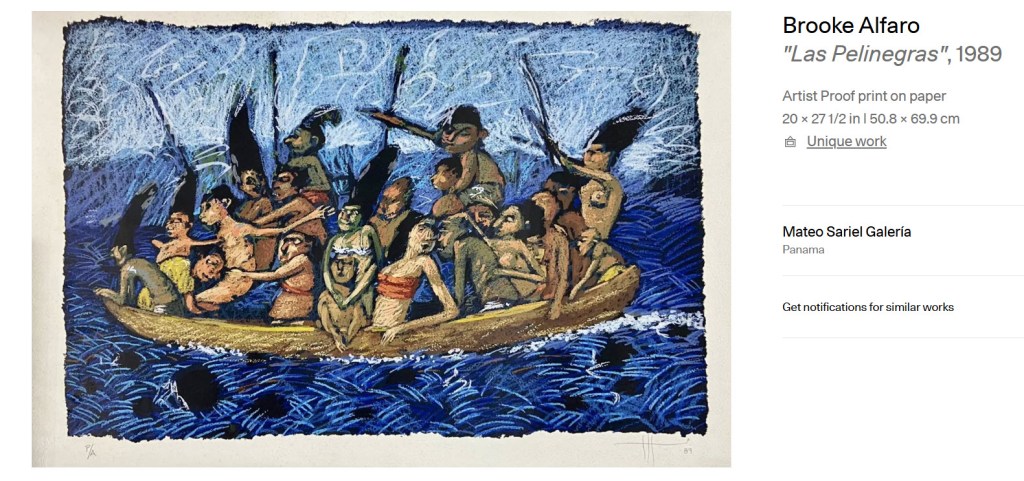
The work below, “The Black-Haired Women”, from a current gallery listing, echoes the subject matter and style of what was shown in the Biennale pavilion. And again, I like it!
From the hole-in-the-wall, little-publicized Panama pavilion, we move to one of the most celebrated and discussed pavilions, that of the Holy See (or Vatican). This pavilion was unique in a number of ways.
To preface this, let’s look at a map of Venice:
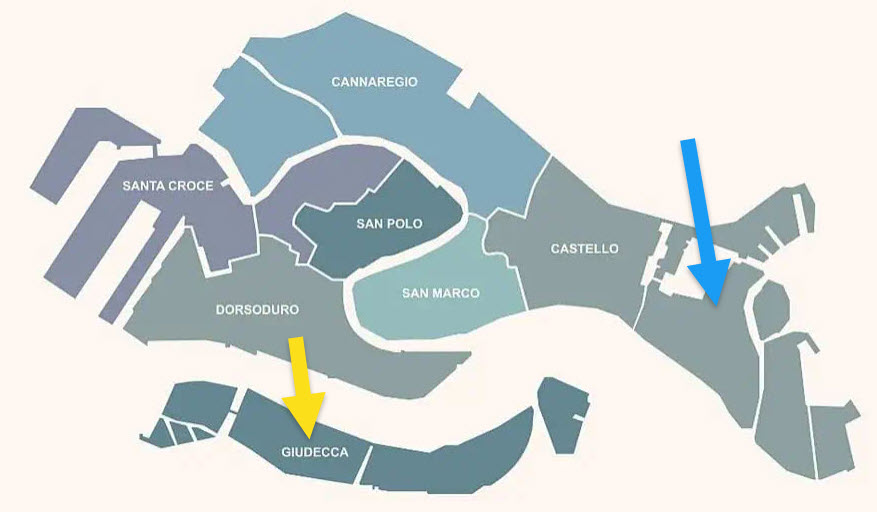
The blue arrow shows where the Arsenale+Giardini are located, where 90% of the Art Biennale takes place. (There are several cultural biennales, including Architecture, which is held in the years alternating the Art biennale.) The remainder of the Art Biennale takes place in rented spaces around central Venice, i.e. the San Marco, San Polo, Santa Croce, Dorsoduro, Castello and Cannaregio districts (called “sestieri” because there are six).
All right, getting back to the several unique aspects of the Holy See pavilion.
First, it was physically isolated. It was located on the island of Giudecca (yellow arrow), a less-visited location and I think a bit more industrial than the others. I’ve been to Venice three times but never to Giudecca, though I want to check it out. To get there you can’t just cross a bridge, you need to take a vaporetto–the public water bus.
Second, it wasn’t in a space typically dedicated to art, i.e. in the Arsenale, Giardini or one of the many rented palazzos around the city. It was held in a radically different space: an active women’s prison. (Originally a 13th-century monastery, the building was converted into a prison for unwed mothers, sex workers, and mentally ill people in 1859. I believe it now functions as a more standard prison for those convicted of crimes.)
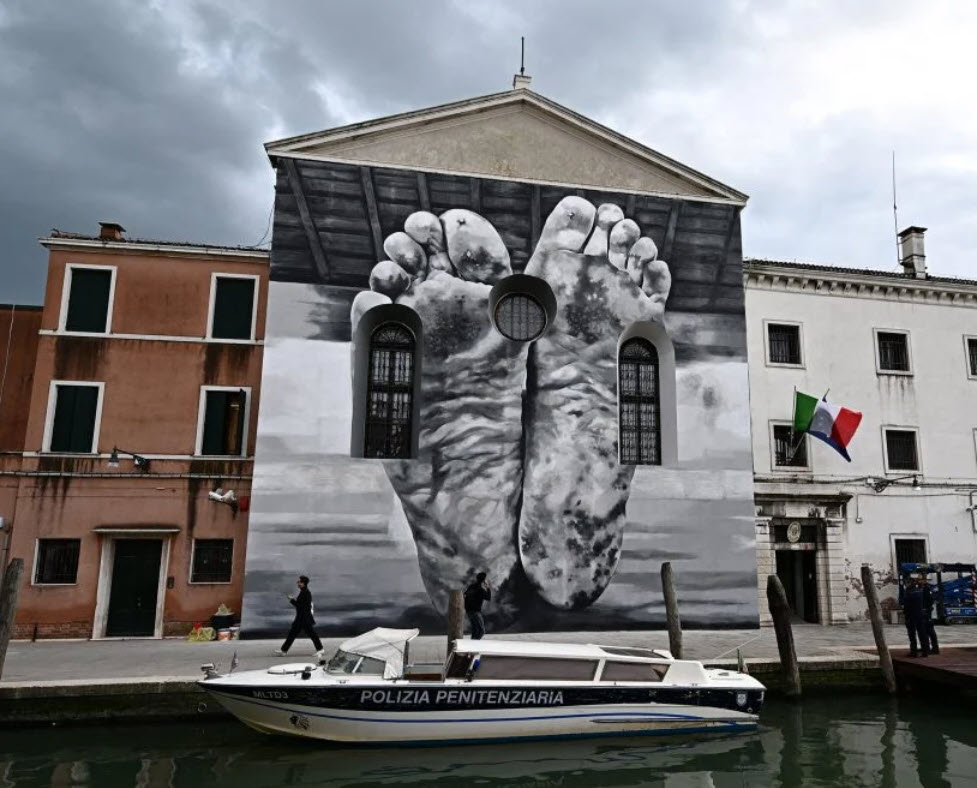
Third, prison inmates were involved in the creation and presentation of the artworks, which were by eight artists. The art also included an Oscar-nominated short film by Italian director Marco Petrego in which his wife, actor Zoe Saldaña, plays the part of a woman being released from this prison. You can read more in deadline.com.
Finally, and logically if you think about it, access to the exhibits was strictly controlled. According to an article in the very interesting online arts journalism site HYPERALLERGIC, only four groups of 25 people, led by a guide and closely monitored, were allowed into the prison each day.
This makes me feel better when I think about the fact that my wife and I didn’t make it over to this much-publicized part of the Biennale!
Here are examples of the publicity, which will provide many more details:
- New York Times, “The Vatican Transforms a Prison Into a Gallery”
- DesignBoom, “the vatican pavilion takes shape within a functional women’s prison at the venice art biennale”
A couple of side notes about the Holy See pavilion. First, Pope Francis (RIP) visited it while we were in Venice, on April 28th 2024. He wanted to see the exhibit, offer prayers and also take the opportunity to meet with prison inmates.
You’ll want to reference the map above for this, or it’ll be confusing. His Holiness also wanted to visit two famous churches of Venice: first Santa Maria della Salute, (pronounced “salu-tay”), next to the Punta della Dogana at the tip of Dorsoduro, and then the Basilica di San Marco where he was to celebrate Mass in the Piazza di San Marco.
He took some kind of boat from the prison in Guidecca to Dorsoduro–likely a fancy and/or historic one of course. Then, when he was finished at Salute, he crossed the Grand Canal to San Marco on foot using a special floating bridge that is periodically put in place for special occasions.
In true Italian style, the special occasions requiring use of the floating bridge are historically two religious celebrations, the Feast of the Redeemer and the Feast of the Madonna of the Salute. In an odd modern twist, the floating bridge is also used for a secular event, none other than the Venice Marathon.
Second side note: the pope’s visit made for an exciting day around Venice, with extra police presence. We even saw a group of sullen people wearing dark overcoats standing silently outside our favorite coffee place. Presently, a smaller group including an older, even more serious-looking fellow walked out and the whole group left the scene. We were told by the “ragazza” (young woman who waited on us) that we had just seen the head of the national police force or Carabinieri. Exciting!
Collateral Exhibitions
My second topic for this post relates to four artists whose work was included in collateral exhibitions, affiliated with the Biennale but not housed in the main locations, the Arsenale and Giardini buildings on the east side of the city.
Now I see in looking at the four artists that none of the related exhibitions took place in rented palazzos, though as I recall, most of the fifty or so collateral exhibitions did. They took place in four very distinct locations that serve to exemplify the always-interesting quirks of Venice.
- Elias Sime’s art was shown in a small commercial gallery space located near the Arsenale on the east side.
- Danial Arsham’s art was shown in the deconsecrated church of Santa Caterina, deconsecrated meaning the space is no considered sanctified by the Church for spiritual use such as celebration of Masses.
- Zeng Fanzhi’s art was shown in the grand and enormous Scuola Grande della Misericordia, near Santa Caterina near the northern edge of Venice.
- Eva Jospin’s art was shown in the Fortuny Museum, which was originally a palazzo but has been a museum since 1975.
OK then, starting with the smallest venue, a commercial gallery, let’s look at the Elias Sime show at the TanArte gallery.
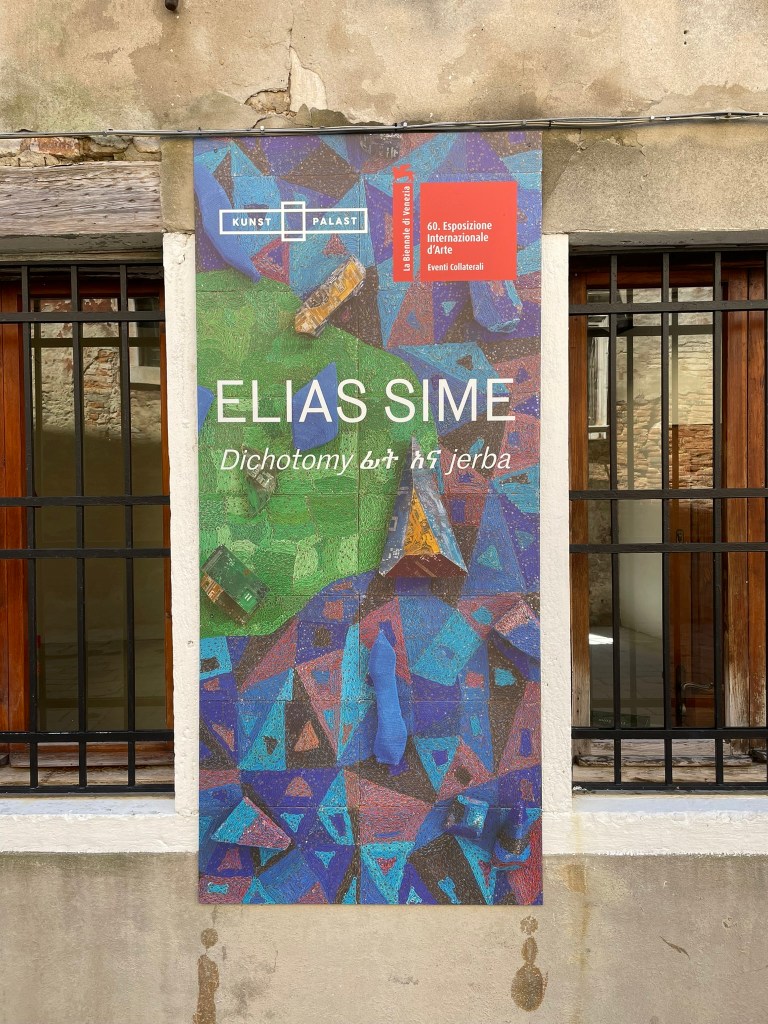
Of course, since almost everything in Venice is quite old, this gallery is in an old and interesting building. Elias Sime is an Ethiopian artist, born in 1968 and based in Addis Ababa, whose work is in the collections of many museums around the world including the Metropolitan Museum in New York, Kemper in Kansas City, DeYoung in San Francisco, and the 21st Century Museum of Contemporary Art in Kanazawa, Japan. He often repurposes electronic waste such as circuit boards, computer keys, and telecommunications wires, which frequently end up (illegally) in Africa, as raw materials of his art. The Mercato in Addis Ababa, the largest open-air market in Africa, is his most frequent source of electronic waste.
His New York gallery, James Cohan, describes Sime’s work well:
For Sime, the history of these materials holds meaning… They suggest the tenuousness of our interconnected world, alluding to the frictions between tradition and progress, human contact and social networks, nature and the man-made.
I agree that the unusual, repurposed materials described above add depth and texture to his works, but mostly I just enjoy them visually. I especially appreciate that works like the one below (and many of Sime’s other works) include three-dimensional elements.
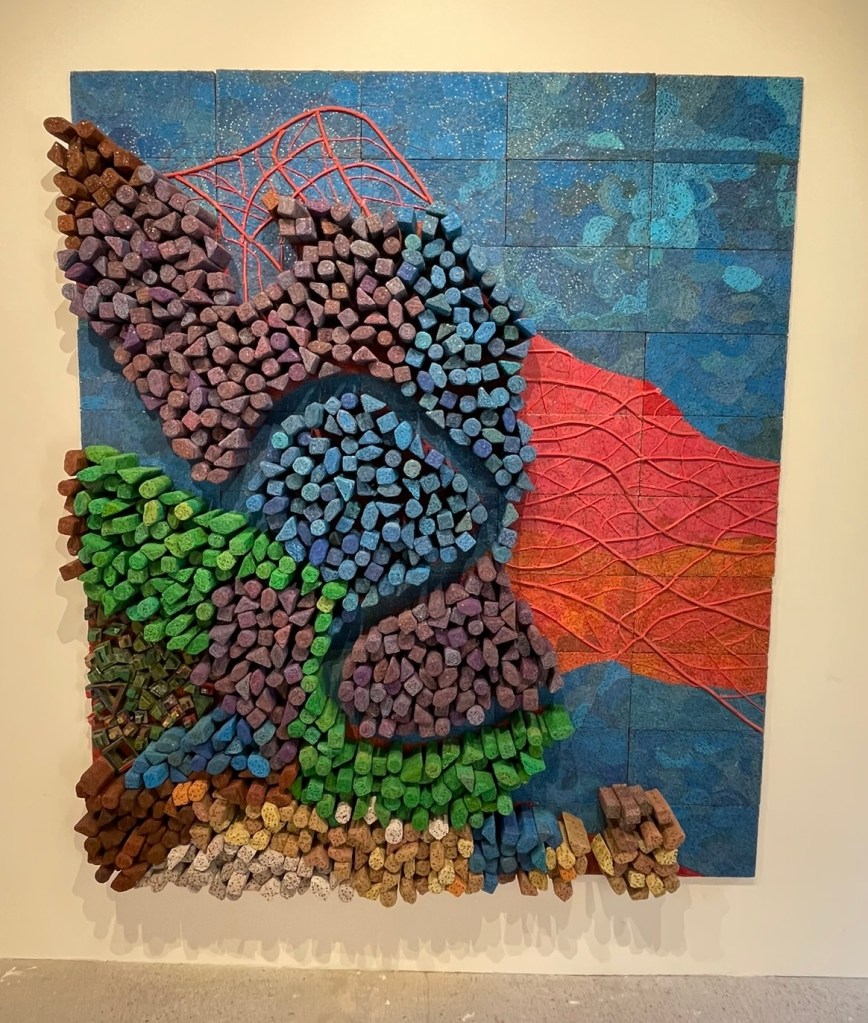
Here’s another beautiful work by Sime that I found listed on the Artsy art auction site, along with an in-depth piece about Sime and “the catastrophic beauty of mineral extraction” in The Art Newspaper.
Next we move to a much larger and more high-profile collateral exhibit showcasing the work of a better-known artist, Daniel Arsham, at the deconsecrated church of Santa Caterina in the Canareggio district.
This was only the second time I had ever seen a deconsecrated church. The first time was just a few days earlier, also in Venice, but Santa Caterina was on a grander scale. Even without considering the artworks, it was a shocking and phantasmagorical experience to see the very old (construction began in the 1200s), crumbling yet still remarkably beautiful church, with a very high ceiling and lots of light streaming in. Coming from a country (USA) where it would be very rare to see something like this, I asked myself “why can’t they put money into it, restore the walls, paintings and sculptures?”. Digging into this question further on the Wikipedia page about the church, it turns out that restoration was underway in the 1970s when the church and many of its artworks were devastated by a fire. This likely contributed to its abandonment by the Church and its present sad yet fascinating state of disrepair.
I found Daniel Arsham’s artworks to be similarly phantasmagorical. I expect to encounter them and this church in my dreams for years. I hope they are somehow pleasant ones!
Arsham is an American born in 1980. His public profile is much higher than that of Elias Sime. He has collaborated with the Merce Cunningham Dance Company, fashion brands and even the Porsche car company. He’s known for “fictional archeology”, which “situates Gen X nostalgia among Classical history”, juxtaposing geologic materials such as crystals with ancient materials such as bronze lookalikes of ancient sculptures, and then mashing them up with recent pop culture iconography like anime figures, often depicted in polished steel.
The work below is a good example. It’s entitled “Split Bust” and is described in detail here. The work is done in a series of 99, each one priced at $12,500 and available through Arsham’s website. Whew! We’ve come a long way from Titian and Bellini painting religious scenes for churches, funded by wealthy local patrons!
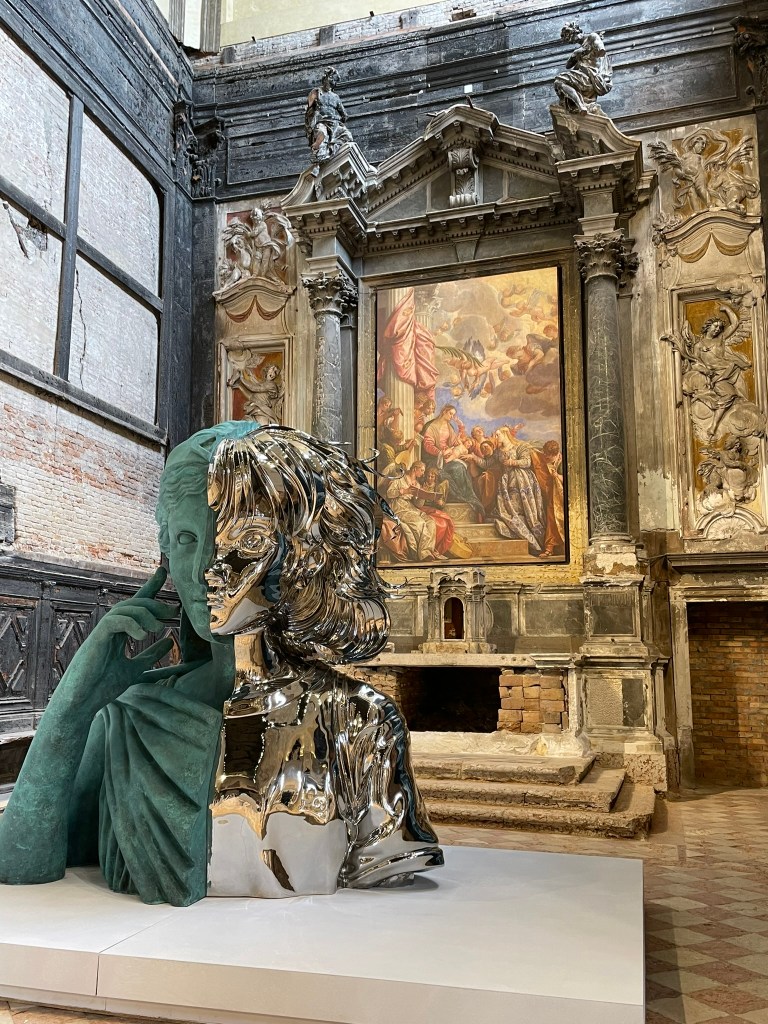
Personally, I enjoy Arsham’s work but the mingling with pop culture imagery sometimes makes it a bit too glitzy or “cheesy” for my taste.

Let’s move on to an artist and site that I’d call quieter and more contemplative–anyway, less phantasmagorical. The artist was Zeng Fanzhi and the site was the enormous and beautiful Scuola Grande della Misericordia. (“Great School of Mercy”)
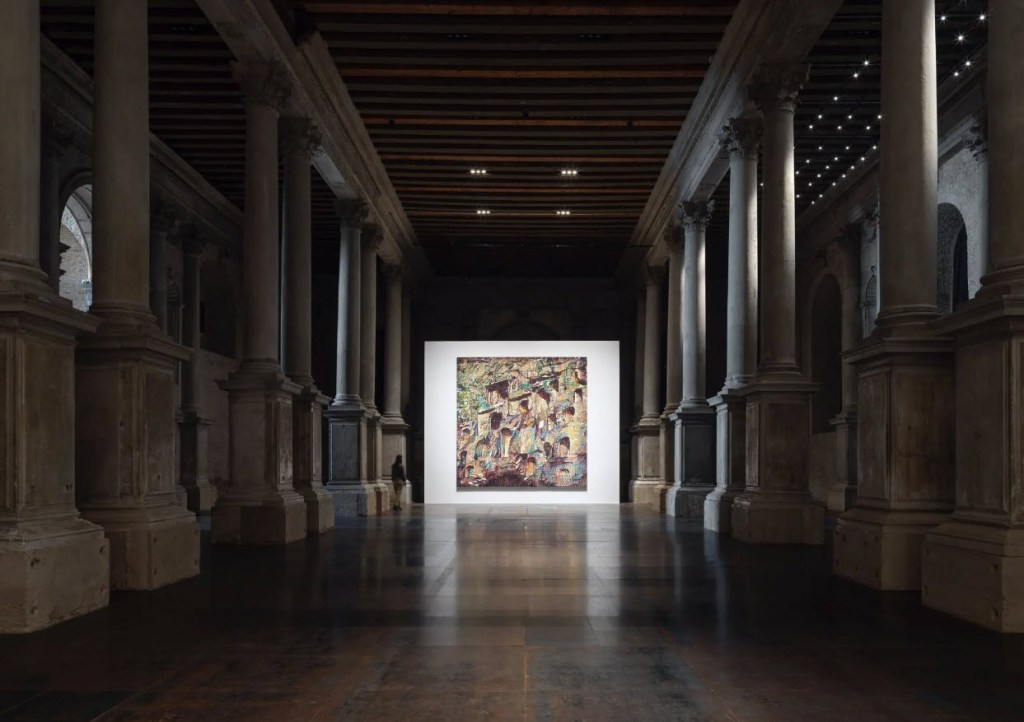
The seven Scuole Grandi of Venice, built between 1200 and 1600, were like clubs or fraternal organizations. Members were middle to upper-income citizens but not part of the aristocracy. They sponsored festivals, contributed to worthy causes and helped the Republic in many ways. We could certainly benefit from such organizations today, but there’s no exact parallel anymore. Perhaps a larger-membership and higher-profile version of a Rotary Club or Lions Club in the USA might be a rough parallel. But unlike a Rotary Club, the Scuole Grandi operated out of large, art-filled and very impressive buildings. The Scuola Grande della Misericordia is the size of a small sports arena of today.
Now the Scuole Grandi serve many purposes, from exhibiting art to hosting Vivaldi concerts to being part of a civic hospital complex. There are also many Scuole Piccoli (little schools), some of which contain amazing art themselves.
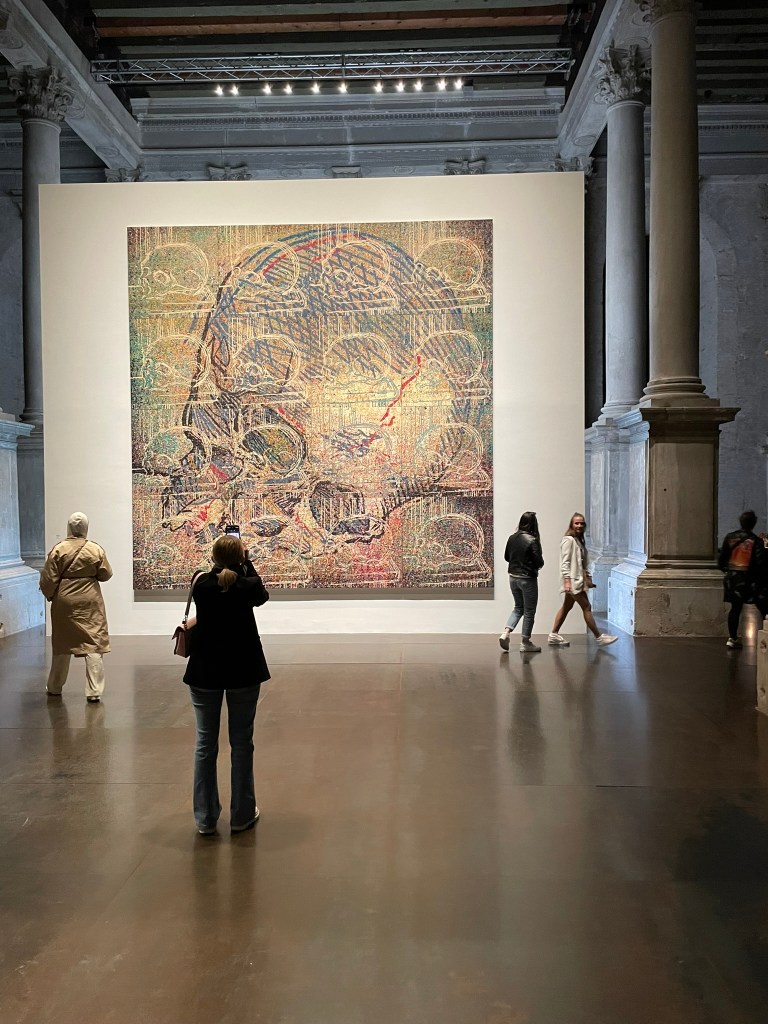


I’m not going to attempt to describe Fanzhi’s works except to say I found them to be beautiful and thought-provoking combinations of figurative and abstract art. This description on the Scuola Grande’s website provides a very good synopsis. I would love to see more of his works in the future.
Of course, one reason why I found Fanzhi’s artworks beautiful and compelling was that they were presented in such a impressive, unique and ancient space. Another important reason was that the space was specially designed and configured for the exhibition by the famous Japanese architect Tadeo Ando, who won the prestigious Pritzker Prize for architecture in 1995. According to Wikipedia, Ando’s “architectural style is said to create a ‘haiku’ effect, emphasizing nothingness and empty space to represent the beauty of simplicity”. Their collaboration at the Biennale, sponsored and curated by the Los Angeles County Museum of Art (LACMA), is described well in this New York Times article.
So far I’ve discussed collateral exhibitions in three very distinct spaces:
- Elias Sime’s work in a small commercial gallery
- Daniel Arsham’s work in a large deconsecrated church
- Zeng Fanzhi’s work in a huge Scuola Grande
Finally, we come to the work of French artist Eva Jospin (born 1975), exhibited in yet another distinct space, the lower level of the Fortuny Museum, located near the Grand Canal close to the geographic center of Venice.
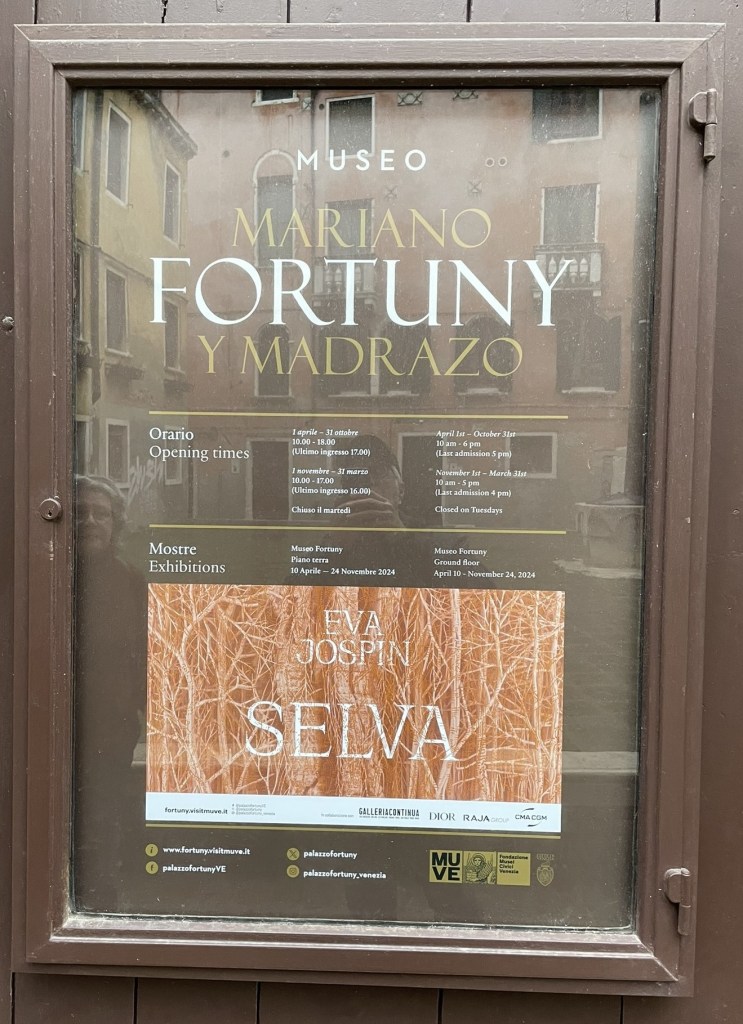
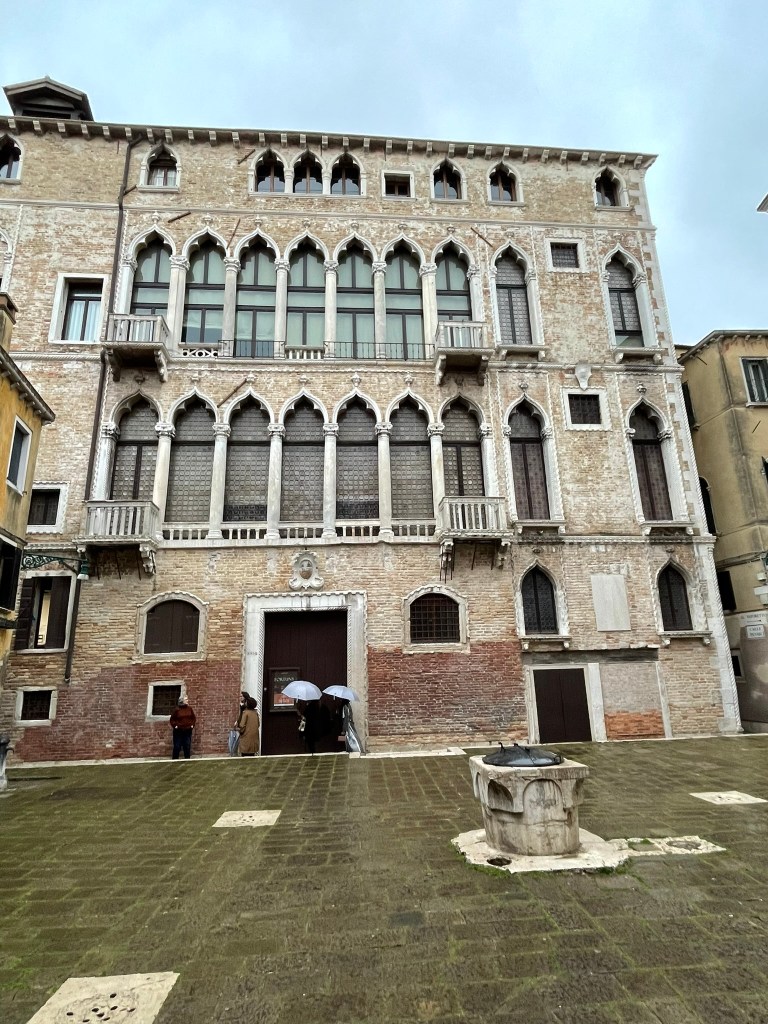
The Fortuny Museum has an interesting history. You’ll see a view of it below. It’s housed in the Palazzo Pesaro Orfei, one of three Pesaro family palaces in Venice. Spanish artist Mariano Fortuny y Madrazo (born 1871), who began acquiring the palazzo buildings in 1898. It’s an understatement to call him an artist, because he was much more: “polymath, artist, inventor, and fashion designer” according to Wikipedia. He is best known for creating, in partnership with his wife, the famous Delphos gown, a simple dress of finely pleated silk. His company continued making and selling this style of gown until 1950. The palazzo was bequeathed to the City of Venice and eventually, after the death of Fortuny’s widow, the Fortuny Museum opened in 1975. It’s a fascinating place and I highly recommend it.
The Fortuny Company still exists, still has a very high reputation for its textiles, and maintains a factory in the Giudecca district of Venice.
Like Daniel Arsham, Eva Jospin has in recent years been not only acclaimed in the art world (recent shows at the Palace of Versailles in France, Mariane Ibrahim gallery in Chicago, and the 21st Century Museum of Contemporary Art in Kanazawa, Japan), but has also participated in joint ventures with for-profit companies including the champagne house Ruinart and fashion company Max Mara, and–most dazzling of all–her creation of the stage set for the Spring-Summer 2023 Dior show (YouTubes here and here).
Jospin’s exhibition at the Fortuny Museum was entitled “Selva”, meaning forest in Spanish. Rather than attempting to describe her work and materials first, I’ll start with some images.
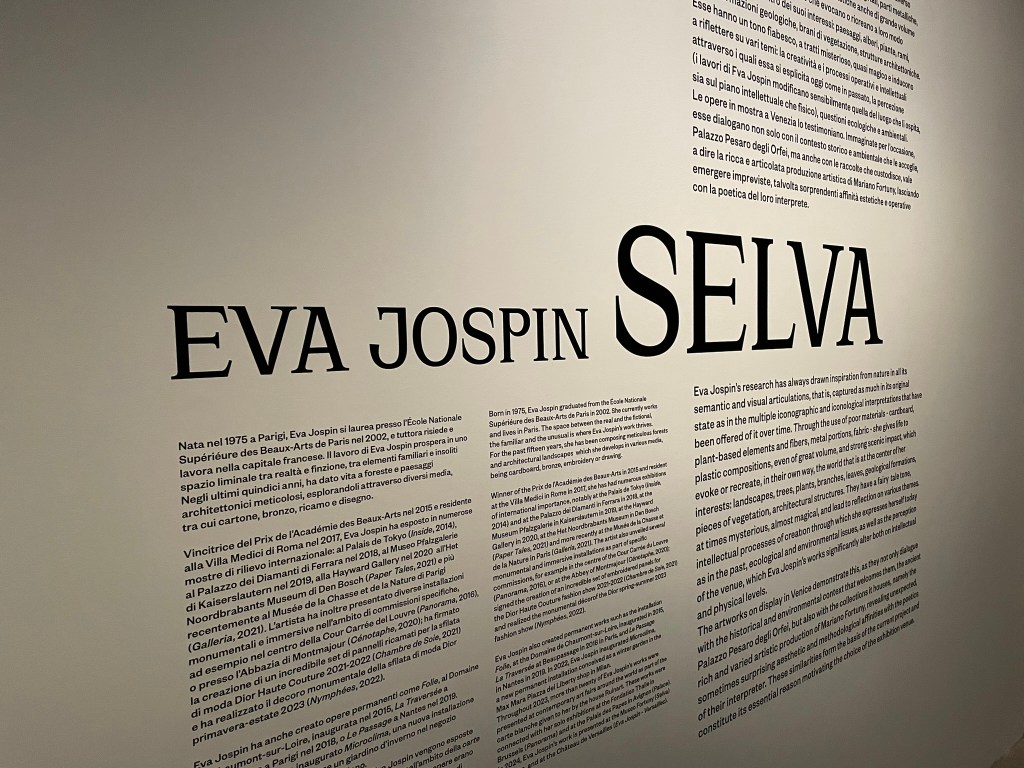

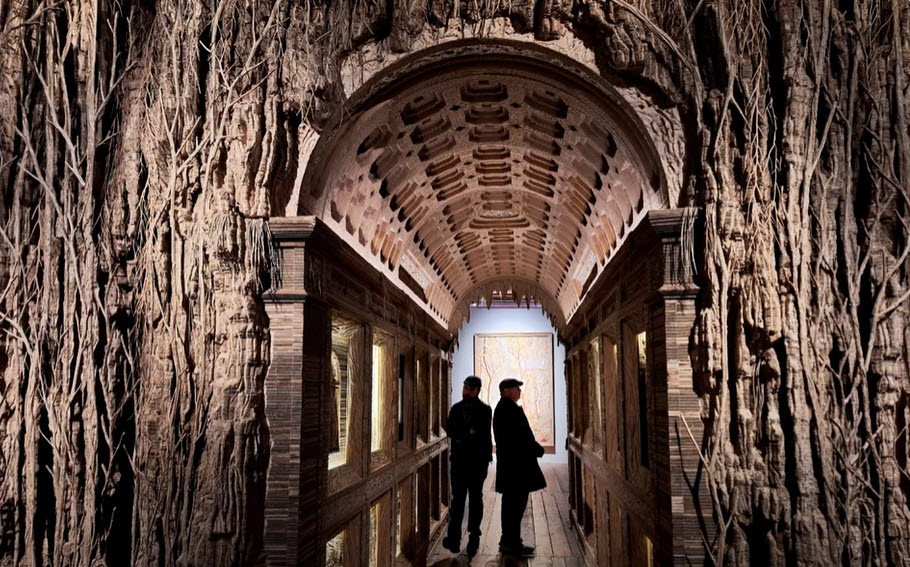
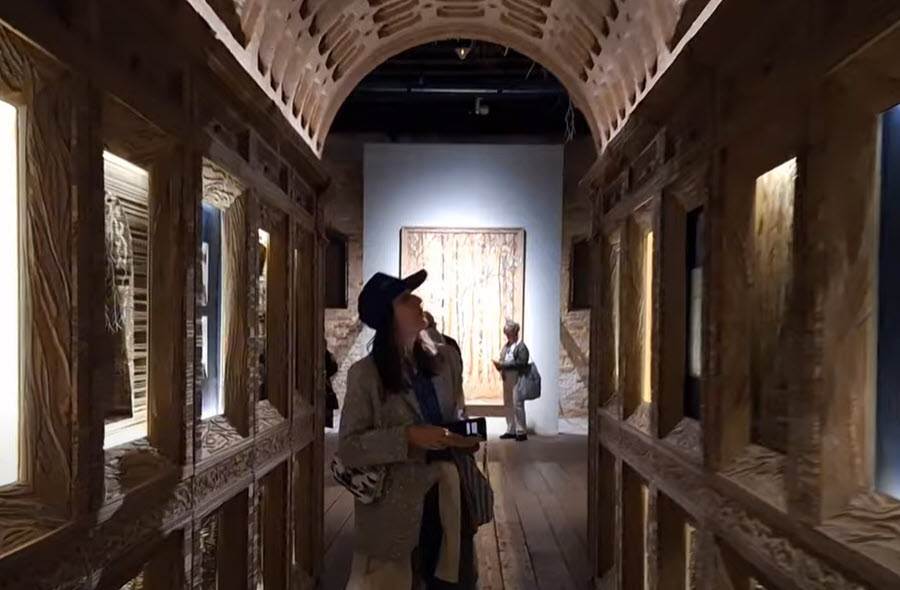
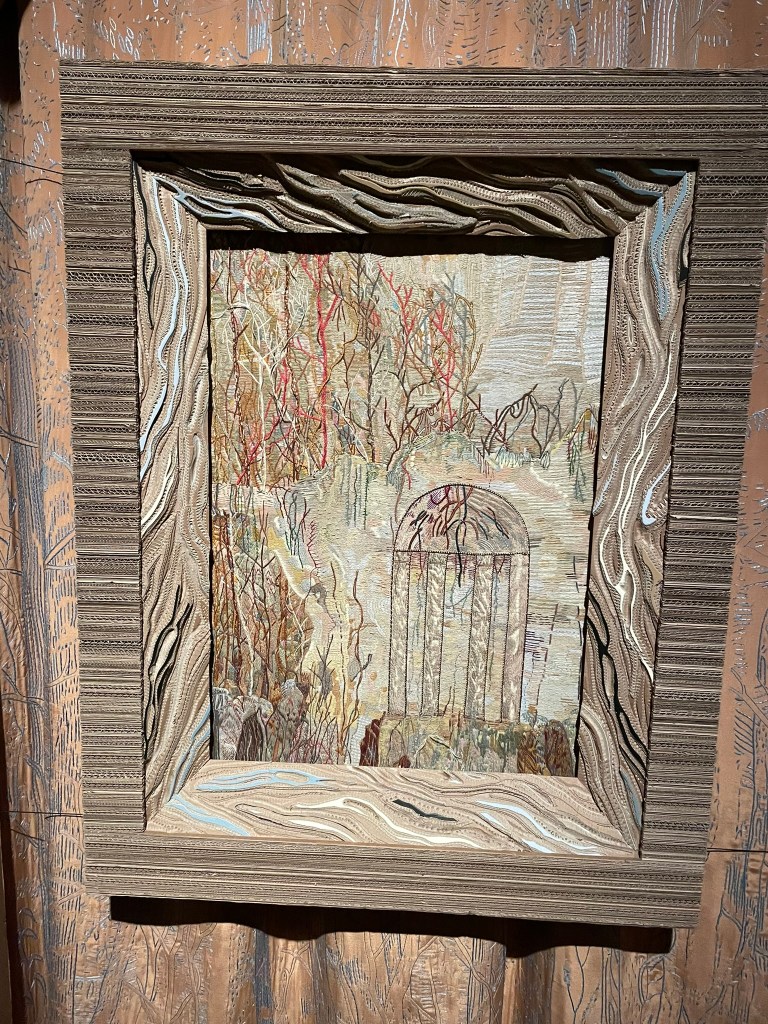
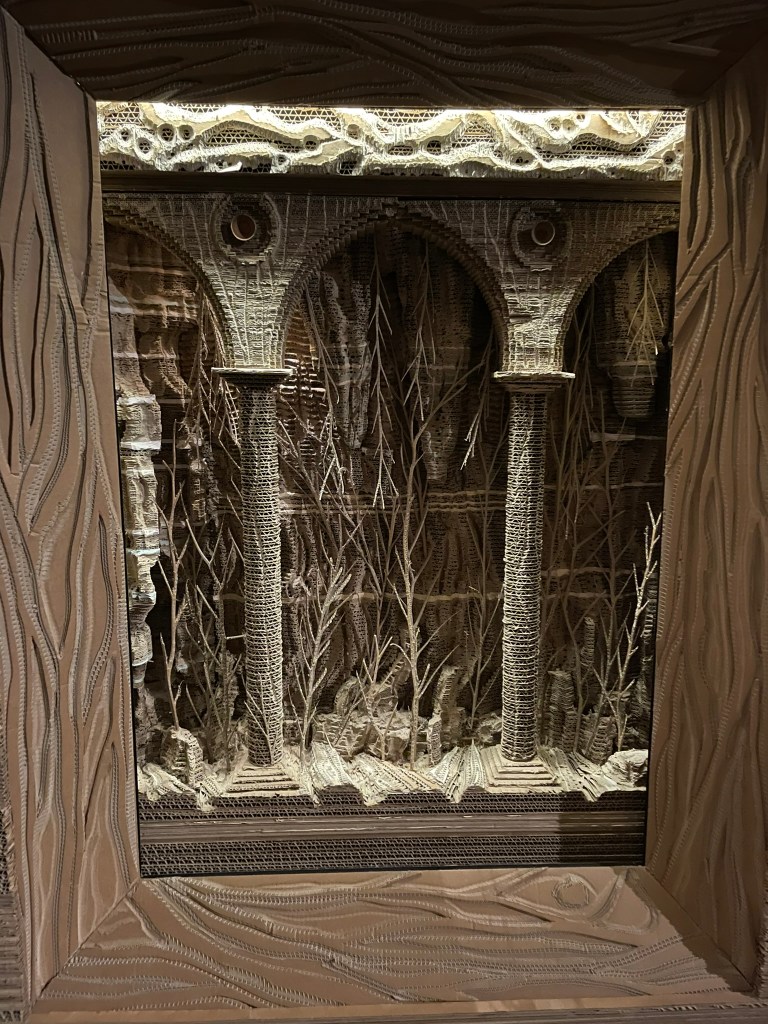
Walking through the installation was like inhabiting a dream world reminiscent of a pleasant but also unsettling Grimm’s Fairy Tale. Hansel and Gretel in the dark forest came to mind. To me, the barrel vault tunnel and precisely-crafted columns added echoes of ancient Greece and Rome, as if the tale’s children were from southern Italy instead of Germany, and stumbled upon ancient ruins. Jospin offered her thoughts about the evocative idea of “finding your way through the forest” in this short video.
Jospin’s exhibition was amazing and, for me, a highlight of the Biennale. Most amazing was realizing that the primary material for all these structures was cardboard. This was the “wow!” factor that I always hope to find in art. It also highlights the level of skill, effort and above all creativity that the artist showcased in creating the exhibition.
That’s it! After three blog posts over close to a year and a half, I don’t have any more artists to talk about! And that’s a good thing, because the last Art Biennale ended nine months ago and the next one will be starting in only eight months. Fortunately though, most of the artists I talked about are still very much alive and producing new works, including all the artists in this post. You can check them out and see how their work is evolving. I certainly plan to.

 Heard and Seen Around Town
Leave a comment