
My most recent post was about the Venice Biennale art show, which my wife and I visited in April of last year. It was a long one, maybe setting my personal blog-post length record, but that was not because I was going for a record (LOL) but because I wanted to talk about a lot of artists and artworks whose work I really enjoyed. I especially wanted to describe them because I had never heard of any of them before.
A friend read the post and, though she enjoyed it, also pointed out that I didn’t go into much detail about any particular art work. Nor did I pick a favorite or provide much in the way of a personal viewpoint. So she asked me to fill this gap – a fair request!
OK, I’ll happily fill the gap. It took me only about a minute of reviewing my extra-long Biennale post to find my favorite artist—Moufouli Bello. Her contribution to the Benin pavilion was the set of paintings below, collectively titled “Night Birds”.
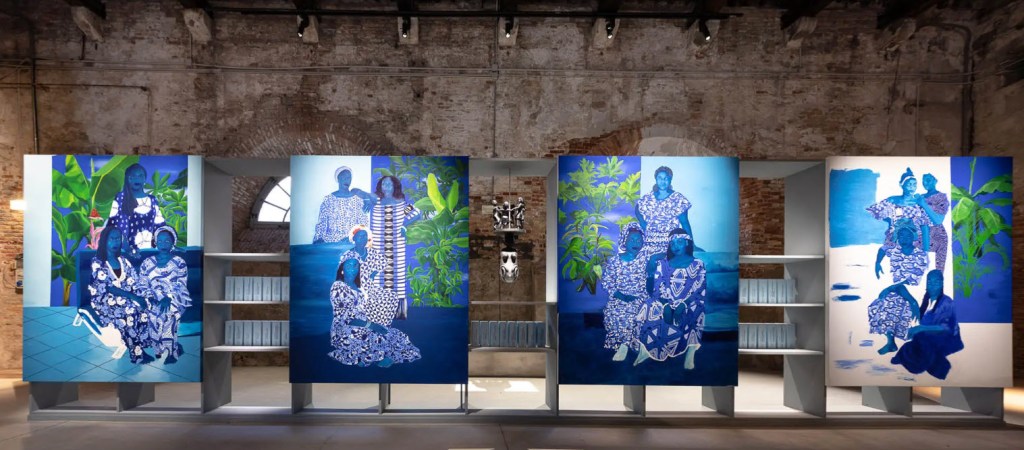
Benin is a small French-speaking country in West Africa, between Togo and Nigeria. Bello’s Wikipedia page is in French but you can click a button to read it in English. She received a degree in international law and later trained as an artist in Brussels and at the Fresnoy school in Lille, France, completing her studies in 2021.
According to the Wiki page, the frequent presence of blue in Bello’s work is not just a preferred hue:
“Bello draws inspiration from Yoruba culture to create portraits of powerful women who embody peace, purity and healing. The color blue predominates in her works. She belongs to the Yoruba ethnic group who dye their fabrics blue from an indigo plant. This color is associated with benevolence, security and home.”
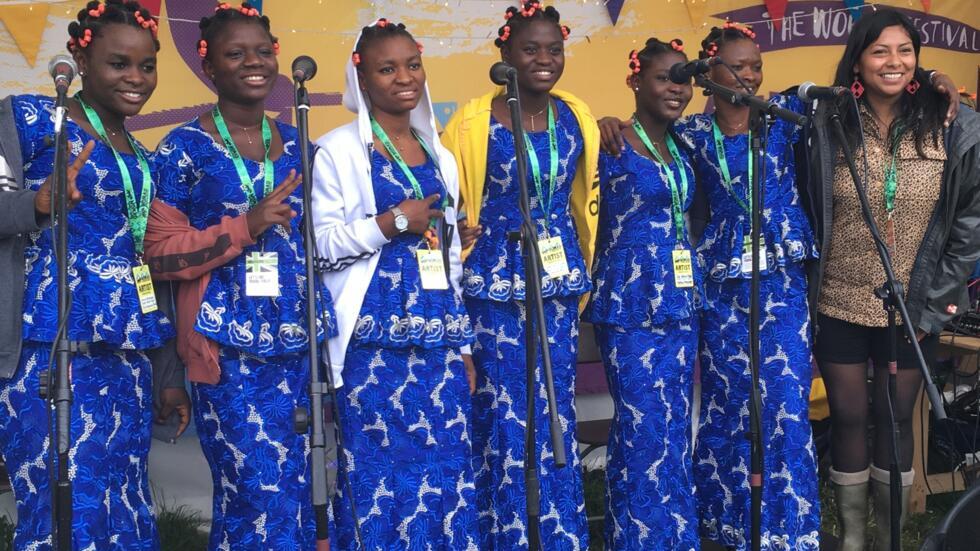
It didn’t take me long to find a photo online of Beninoise women wearing blue.
Bello’s paintings were a major part of the first-ever Benin pavilion in the 2024 Biennale, which is well-described in this article in Hyperallergic, an online publication based in Brooklyn.
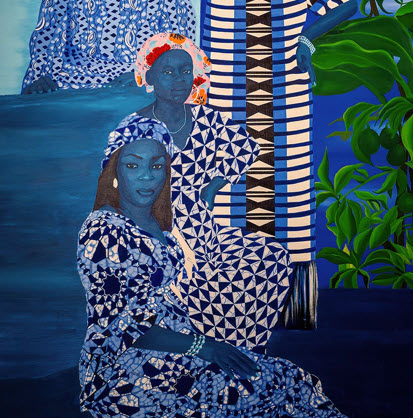
Here’s a detailed view of one of the paintings at the top of this post:
This one is also part of the “Night Birds” series but it doesn’t seem to have been included in the Biennale. I found it on the website of SMO Contemporary Art:
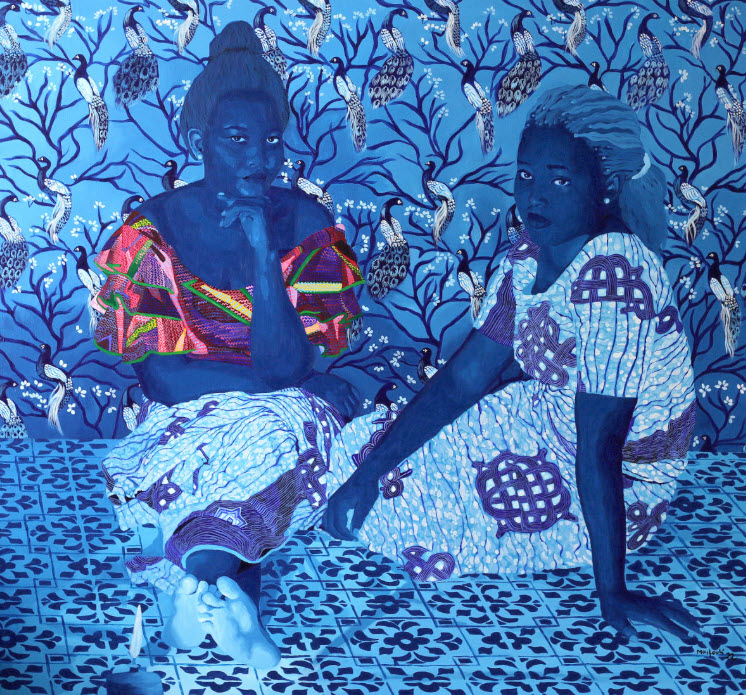
Seeing Bello’s paintings, I first felt the rush of the vibrant, gorgeous colors. Then I was struck by the steady gazes of the women. Not smiling, not looking up, down, left or right: just gazing directly at the viewer. I wondered why they were depicted this way.
After pondering my place as an art viewer, reading this article in the Brooklyn Rail and listening to this CNN report, which includes Bello’s thoughts on the paintings, I began to see more meaning in the paintings—especially the steady gazes.
First, as an art viewer I represent the most privileged view possible: a relatively affluent Western white man. Though I’m not in the elite category of someone who might have commissioned a portrait from Rembrandt, Sargent, Gilbert Stuart or other portraitists of the past, nonetheless I’m in the category of humans who have typically been enshrined in portraits in the past – the same category who have typically led museums, been curators and made decisions about whose faces should be represented in elite settings like a museum or gallery.
Second, I learned from the Brooklyn Rail article that Bello took photographs of “ordinary women” who worked near her studio – “tailors, hair stylists and family members” – and depicted them in the paintings.
Finally, I heard Bello’s description in the CNN report: “I want my work to leave a mark on the audience… when we look at these women, when we meet their eyes, we find it hard to forget them. But I also want you to see that they’re human beings, just like the person looking at the painting.”
Like the title of this essay, the steady gazes of these women are announcing “We’re here”.
Times have changed—for the better. Setting aside the obvious point that if you bankroll the artwork, you’re free to be featured in it, a hair stylist in Benin is just as qualified to be in a large-scale portrait as a king, pope or business executive; in fact, one could argue that she is more qualified, for three reasons:
- Popes, kings, nobility, political leaders and business executives (likely white males over and over) have been over-represented in the past
- The native countries of the above have also been over-represented
- Her life and circumstances, including appearance, clothing and surroundings have not been explored and depicted by artists nearly as often as the “usual suspects” have been
It was an interesting—and humbling—experience for me to first be struck by the vibrant beauty and uniqueness of Bello’s paintings, while being puzzled by the expressionless, steady and direct gazes of the women being depicted; and then, after some pondering, background research and reading, appreciating the additional layers of meaning coming from Bello’s choice of subjects and her desire that “when we meet their eyes, we find it hard to forget them.”
When I say “expressionless” I’m referring to the lack of specific facial expressions such as a smile, frown, raised eyebrow, worried look, etc. But an “expressionless” gaze, especially when brought forth by a skilled artist, can still project attitudes and emotions. Looking at the women again, their gazes can be interpreted as showing pride or even defiance. I’m sure that these “everyday women” in Benin have encountered and likely overcome many challenges. They are certainly justified in showing pride in their gazes, and I think this is part of why Bello wanted us to find it hard to forget them.
Another painting that announces “I’m here”
Ever since my visit to the Venice Biennale last April, I’ve been thinking about the direct and steady “I’m here” gazes of the “Night Birds”. Several months later I was in Boston visiting the Isabella Stewart Gardner museum, which I hadn’t visited in twenty or thirty years. Once again I had the double-take experience of being drawn to a painting by its surface characteristics—colors, setting and characters in this case—but overlooking additional layers of meaning that I later understood with the help of commentaries, this time from a museum audio guide.
The painting was Anders Zorn’s “The Omnibus” (1892). You can read about it in the Gardner catalog here.
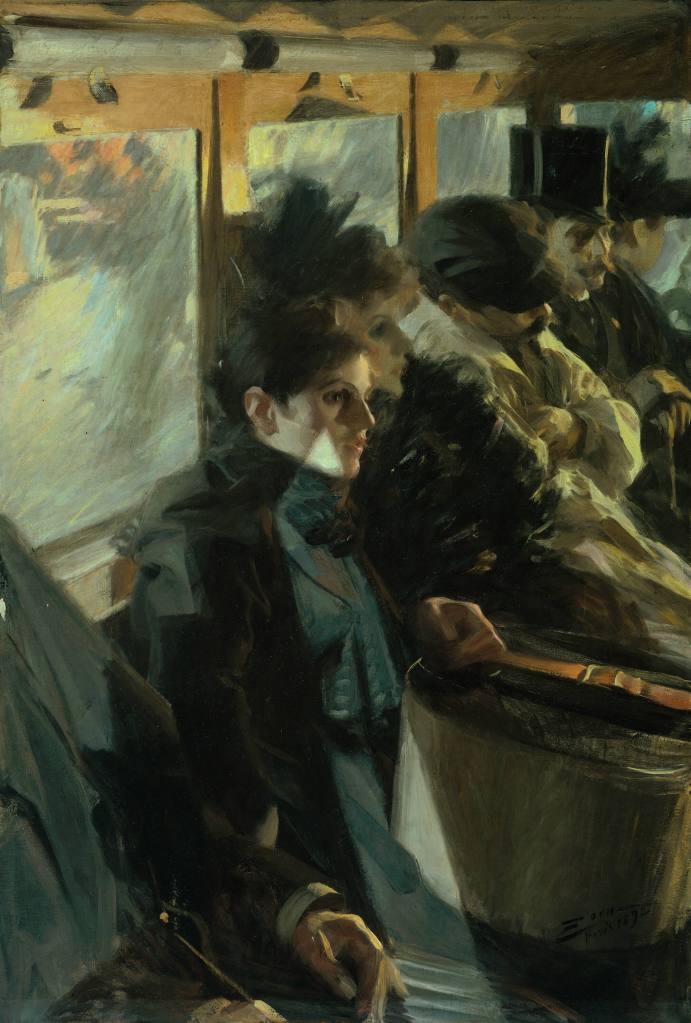
In the case of “Night Birds” the woman who opened my eyes was the artist herself with her commentary in the CNN report; with “The Omnibus” she was Casey Riley, a consulting curator who provides the museum-provided audio commentary for the “Blue Room” gallery where the painting can be seen.
Before talking about Riley’s interpretation, though, an introduction to both Isabella Stewart Gardner and Anders Zorn would be worthwhile. Making use of the Writer’s Friend—Wikipedia—you can read the background on Gardner (1840-1924) here and Zorn (1860-1920) here. For our purposes, you mainly need to know the following:
- Gardner was a wealthy Boston heiress who established her famous museum in 1903 to showcase her growing collection of mostly European art. It was built in the style of a Venice palazzo. The first three floors contains the art; Gardner herself, a widow by then, lived on the fourth floor.
- Zorn was a Swedish artist who was “one of the most acclaimed portrait painters of his era” (Wikipedia).
- He was known for using a basic color palette consisting of lead white, yellow ochre, vermilion and ivory black.
- Zorn and Gardner were friends and Gardner was one of his most frequent patrons. One of the best-known paintings of Gardner is Zorn’s “Isabella Stewart Gardner in Venice, 1894”, commemorating a night when the Zorns and Gardners were visiting the Palazzo Barbaro on the Grand Canal.
- The Gardner Museum contains the most comprehensive collection of Zorn’s work in the U.S.
Now about “The Omnibus”. The museum website/catalog description begins with a rather pessimistic, almost Dickensian view of the painting (an unnecessarily pessimistic view I think), but goes on to point out that Mrs. Gardner may have identified with the young woman in the foreground:
Why was Mrs. Gardner so drawn to this work when she saw it in Chicago? [at the World’s Columbian Exposition in 1893] It is a thoroughly modern painting: the subject is contemporary urban life—people sitting on a Paris trolley—and the style is Impressionist, although the Impressionists never really painted the dreary aspects of public transportation. Zorn depicts the isolation and sadness that comes with industrial progress, even as people are more crowded together. It has been reported that Mrs. Gardner rode the streetcars of Boston, and thus could have identified with the well-dressed women riders. And, if a bit of speculation is allowed, the woman in the foreground, apprehensive yet eager, leaning and looking forward, mirrors the aspect of Mrs. Gardner at this moment in her life—about to embark on a serious career of collecting.
The above comes from Eye of The Beholder: Masterpieces from the Isabella Stewart Gardner Museum, by Richard Lingner.
Lingner’s speculation that Gardner identified with the young woman in the foreground seems to be borne out by these comments about “The Omnibus” that I heard in the museum audio guide:
Stop 105: Blue Room
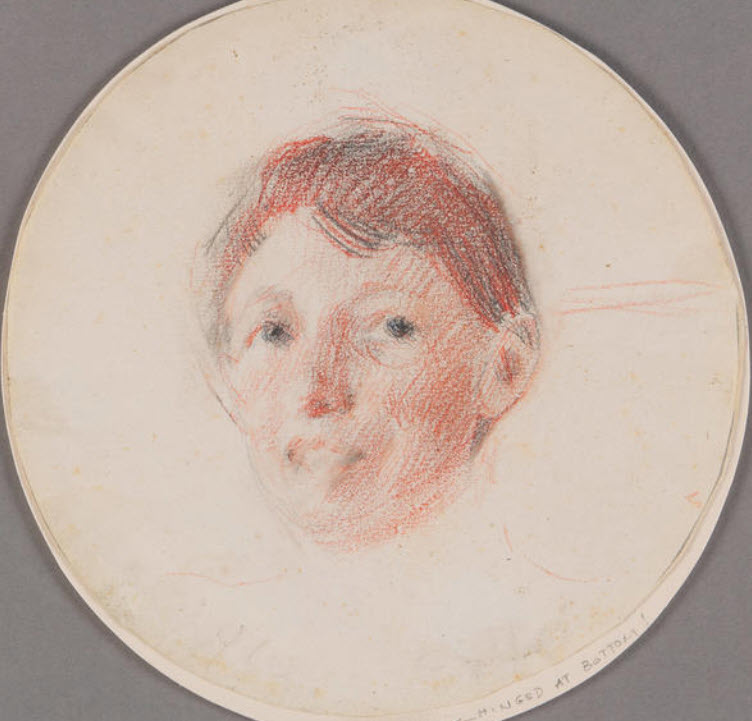
Hello, I’m Casey Riley; as Consulting Curator, I work with Isabella Stewart Gardner’s personal archives. And this room is full of objects that reveal her personal relationships. Many of the paintings on the walls were created by her closest friends. She installed these alongside decorative arts, furniture, and textiles, as well as letters and photographs from her friends. Throughout the museum, she delighted in connecting her everyday life with extraordinary objects. Now, turn towards the wall with two windows. Between the windows, there’s a wall jutting out. Just in front of it, there’s a metal lantern hanging from the ceiling. It’s in the shape of a boat. I want to point out something just under that boat lantern. Do you see the little round portrait, in the ornately carved frame? It’s Isabella! I thought you’d like to meet her face-to-face. Her friend Anders Zorn drew this in Venice–see how her blue eyes sparkle! I think it captures her legendary charisma.
Now, facing Isabella’s portrait, move just slightly to the left, just around the half-wall. There’s a case under the large painting. We have to keep it covered because Isabella’s mementos inside are sensitive to light. She arranged her cases very carefully: curating her life alongside her collection of art.

Now, look at the photo of the woman in this case, in the right corner. Her hair is neatly coiffed, and she looks determined. She’s the social reformer and champion of women’s rights, Julia Ward Howe. [also an abolitionist and author of the "Battle Hymn of the Republic"]  We can’t always make specific connections between what Isabella put in a given case and a nearby work of art. But I do see a connection here! With that big painting on the wall just above it! It shows us newly emancipated, unchaperoned women, on public transportation in Paris.
This characterization really rings true to me, especially because of the juxtaposition with the photo of Julia Ward Howe.
And it reminded me of Moufouli Bello’s “Night Birds” paintings showing the hair stylists and tailors of Porto-Novo, Benin, with their steady, serious gazes. Like them, the young women in Zorn’s painting seem to be saying “I’m here”: “Times have changed—I don’t need to be chaperoned and can’t be bothered with that formality. I have independent goals and I’m bold enough to pursue them.”
Gardner, who could certainly have afforded a private taxi but apparently often used public transportation, is also underscoring her insistence on experiencing all aspects of life and not being sheltered like most wealthy widows of the time. All of these interpretations resonate with the stories of her high-spirited, convention-ignoring and charismatic personality—as shown in this story from the gossip magazine “Town Topics”, about her celebrating the 1912 World Series victory of the Boston Red Sox:
“That Mrs. Jack Gardner should resort to such sensational methods to keep herself before the public eye as to wear in public a white band with “Oh, You Red Sox,” in red letters on it, looks as if the woman had gone crazy. With this band bound like a fillet around her auburn hair, she appeared in her conspicuous seat at a recent Saturday night Symphony Concert, almost causing a panic among those in the audience who discovered the ornamentation, and even for a moment upsetting [the orchestra members] so that their startled eyes wandered from their music stands.”
All right, enough about the “I’m here” messages of these paintings.
I do, however, have a couple more things to say about them in other respects. I want to highlight and compare the qualities that most struck me in each of these artworks.
What struck me most about “Night Birds” was the immediate Wow! factor of the bright blues and greens; the steady, direct gazes of the women; the fascinating textile patterns in what they’re wearing (are they traditional? modern? a mix?); and the feeling that I have a lot to learn about these people, their lives and the place where they live.
In contrast, what struck me most about Zorn’s “The Omnibus” were subtle details that only emerged after viewing and pondering. For example, despite the rather dim interior of the omnibus, Zorn has with a few brush strokes clearly delineated the four passengers whose faces we see. The two women, especially, are shown with great subtlety. The one in shadow seems relaxed but also very alert, in contrast to the slumping, utterly relaxed man dozing next to her. It seems likely that she is experienced with riding this new-ish mode of transport, but at the same time well aware of the hazards for a woman doing so. Zorn really shows his portrait skills with the woman in the foreground. Somehow he manages to show both nervousness and determination in her eyes, and the drama is accentuated by the “arrow” of light that’s pointing toward her eye, while still remaining perfectly plausible—likely a reflection of sunlight from some object outside the omnibus. Its muted colors make this a painting I could easily have overlooked, considering my enjoyment of bright colors like Bello’s. But I’m happy to have spent time viewing it and reading about it, so that I appreciate it more.
I’m pleased to say that I’ve reserved the same VRBO for next April in Venice, so assuming both my budget and health hold up, I’ll be able to search for my next Moufouli Bello. Looking forward to it!
 Heard and Seen Around Town
Leave a comment