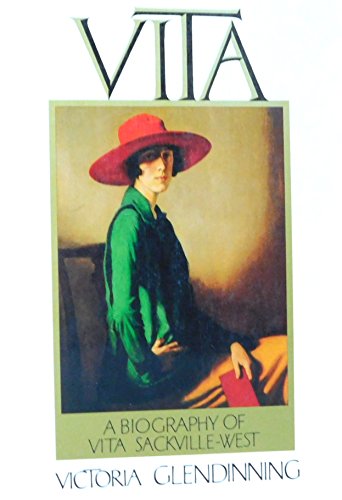
Book Review: Vita: the Life of V. Sackville-West by Victoria Glendinning, published by Phoenix, London, 1983. (5 out of 5 stars).
I really enjoyed this book. Victoria Glendinning is a very skilled and fluent writer, like (I think) a higher percentage of British than US writers. If the author is one of those highly articulate and witty British writers, I will probably read a biography of the local postman or curate in any obscure English village.
I’m also an Anglophile, usually, and was already somewhat familiar with parts of this story. I read the book because my book club read Virginia Woolf’s Mrs. Dalloway. As background for that, I read some other material about Woolf and her circle; and that got me interested in Vita Sackville-West.
First, a little background on her. Victoria Sackville-West, called Vita to distinguish her from her mother, came from a long line of English aristocracy on her father’s side. An ancestor was Thomas Sackville, 1st Earl of Dorset, whose father was a cousin of Anne Boleyn. Sackville played important roles under Queen Elizabeth I including Lord High Treasurer. Her mother was less “blue blooded”, being the illegitimate daughter of a Sackville relative – Vita’s parents were first cousins – and a famous Spanish dancer of Romani background, Pepita. Vita eventually became famous herself as a newspaper columnist, novelist and as one of Virginia Woolf’s lovers. Woolf’s novel Orlando is based on the life of Vita and her family over the centuries. The novel describes the adventures of a poet who changes sex from man to woman and lives for centuries, meeting the key figures of English literary history. The novel has been adapted into plays and films numerous times, with the lead role being played by such luminaries as Miranda Richardson, Isabelle Huppert and Tilda Swinton.
Speaking of luminaries, the more I think about Vita the more I’m reminded of one of my favorite movies, Gosford Park, and Maggie Smith’s hilarious but also sad role in it as the Dowager Countess of Trentham.
Vita was clearly a charismatic personality, and the many stories of her friendships and love affairs with women are fascinating. Her aristocratic background never failed to add a mystique and appeal when she became friends with women who were more formally educated but didn’t have an aristocratic background. The many stories about Knole, the huge family estate in Sevenoaks, Kent, south of London where Vita grew up, are always interesting.
Before reading the book or knowing much about Vita, one might think she mainly capitalized on her wealthy background and didn’t need to achieve much on her own; but one of the interesting themes of the book is the on-again, off-again nature of her wealth, and in reality she made a lot of money from her middlebrow but celebrated career as a novelist and poet. At times she spent lavishly – for example, buying a Rolls-Royce and having a chauffeur! – but at other times she worried about money and had to cut back, while her husband Harold, from a less wealthy background, seemed to be always fretting about money.
Vita was the primary force behind the resurrection of a now well-known country house estate south of London, Sissinghurst, and turning it into a tourist site known for its innovative gardens. It wasn’t simply an estate that she inherited, and in fact both the challenge and opportunity of her life was the fact that, being a female member of the English aristocracy, she could not inherit Knole from her father, despite being an only child.
One of the delights of the book is that most of the participants wrote very literate letters to each other constantly. In fact, Harold and Vita were often apart (convenient since they were pursuing their own independent love lives and friendships) but wrote to each other multiple times a week or even, at times, every day. Sometimes the letters between Vita and Harold are a bit too overwhelming with declarations of love – especially for two people who are actively pursuing lovers on the side! But it seems that the two really did love each other in their own way, and were loyal to each other to the end.
The book provides interesting glimpses of historical events, especially World War II. Sissinghurst was on the path of bombers coming from Germany during the war, creating some vivid, dramatic scenes.
Vita was not an innovator in literature or art like her friends in the Bloomsbury group such as Virginia Woolf, her sister Vanessa or Vanessa’s husband Clive Bell. Some of the forward-looking writers, artists and intellectuals of the time made fun of Vita’s middlebrow taste and writings. Her leadership was in two other areas: her charismatic personality with its resulting long series of Sapphist (i.e. lesbian) love affairs (her relationship with Virginia Woolf being the best known), and her innovations in gardening at Sissinghurst.
I highly recommend this book to anyone interested in the cultural history of England in the early 20th centory. I plan to look for other books by Victoria Glendinning, because I find her to be a highly skilled and entertaining biographer.
I’m hoping to visit both Knole and Sissinghurst in the future. If I’m not mistaken, both are National Trust sites and open to the public. In fact, I ‘m sure that Sissinghurst is a National Trust site. The book mentions many times that Vita, whose finances, as I mentioned, were often a bit shaky – buying Rolls-Royces can have that effect! – worried that in the long run one of her worst fears might become reality: for financial reasons Sissinghurst and its gardens would need to be sold. Of course, this was a common fate for large English country houses in that era, so Vita was not alone in having to deal with daunting costs and avoiding the wrecking ball. Sure enough, you can now visit Sissinghurst for the sum of 13 pounds, with a discount for members of the National Trust!

 Heard and Seen Around Town
Leave a comment